Views: 0 Author: Site Editor Publish Time: 2026-07-19 Origin: Site


Traditional treated lumber seems budget-friendly at first glance. However, the high upfront cost barrier of synthetic alternatives often scares homeowners away. Many abandon their dream backyard upgrades before even breaking ground. To compensate, buyers often compromise on material quality to save money upfront. This dangerous shortcut frequently results in premature failure. Severe board warping occurs rapidly. Sometimes manufacturers completely void the warranties due to poor product choices. Homeowners quickly regret these decisions when boards fade or splinter. Building a budget-conscious outdoor space requires a highly strategic approach. You must select cost-optimized materials like scalloped profiles. Furthermore, you must utilize highly efficient installation strategies. These methods significantly reduce both labor hours and material waste. By following this blueprint, you learn how to secure premium aesthetics on a tight budget. You will discover smart design choices protecting your outdoor investment for decades. We will guide you through every cost-saving phase.
Material Selection: Scalloped WPC decking reduces material weight and cost by 20-30% without sacrificing structural integrity.
Substructure Savings: Inspecting and reusing an existing pressure-treated wood frame is the highest-impact cost-saving measure.
Fastening Systems: Face-screwing is cheaper upfront, but budget-friendly hidden fastener clips provide better long-term value and structural safety.
Design Efficiency: Standardizing deck dimensions to match 12-foot or 16-foot board lengths minimizes expensive off-cut waste.
Defining your success criteria establishes the foundation for your project. A successful low-cost build prioritizes long-term return on investment. You want low maintenance over simply buying the cheapest uncapped boards available. True success means minimal upkeep across the lifespan. We look for extreme durability. Fading resistance matters deeply for visual appeal. Uncapped boards degrade rapidly under sunlight. You will spend more money replacing them later. Budget building requires smart material longevity.
Let us break down the typical cost allocation for a standard project. A deck budget splits into several distinct categories. You pay for the pressure-treated lumber substructure. You purchase the synthetic surface boards. Fastening hardware consumes a small but vital percentage. Labor usually takes the absolute largest chunk. Understanding these categories reveals exact optimization points.
Budget Category | Average Cost Percentage | Primary Function |
|---|---|---|
Labor | 40% - 50% | Professional installation and site preparation |
Surface Boards | 25% - 35% | Visual decking material and cap layer |
Substructure | 15% - 20% | Joists, beams, and structural support |
Hardware | 5% - 10% | Screws, clips, and fastening systems |
We must emphasize the labor versus material paradigm here. DIY installation shifts your budget entirely toward higher-quality materials. Even partial DIY prep work saves thousands. You can redirect those funds immediately. Instead of wasting funds on labor, redirect them to purchase high-quality Composite Decking,WPC decking for your surface layer. Contractors charge premium hourly rates for basic demolition. Doing this yourself makes premium capped boards completely affordable. You essentially trade your weekend sweat equity for superior polymer capping technology. This strategy guarantees a much better outdoor living space.
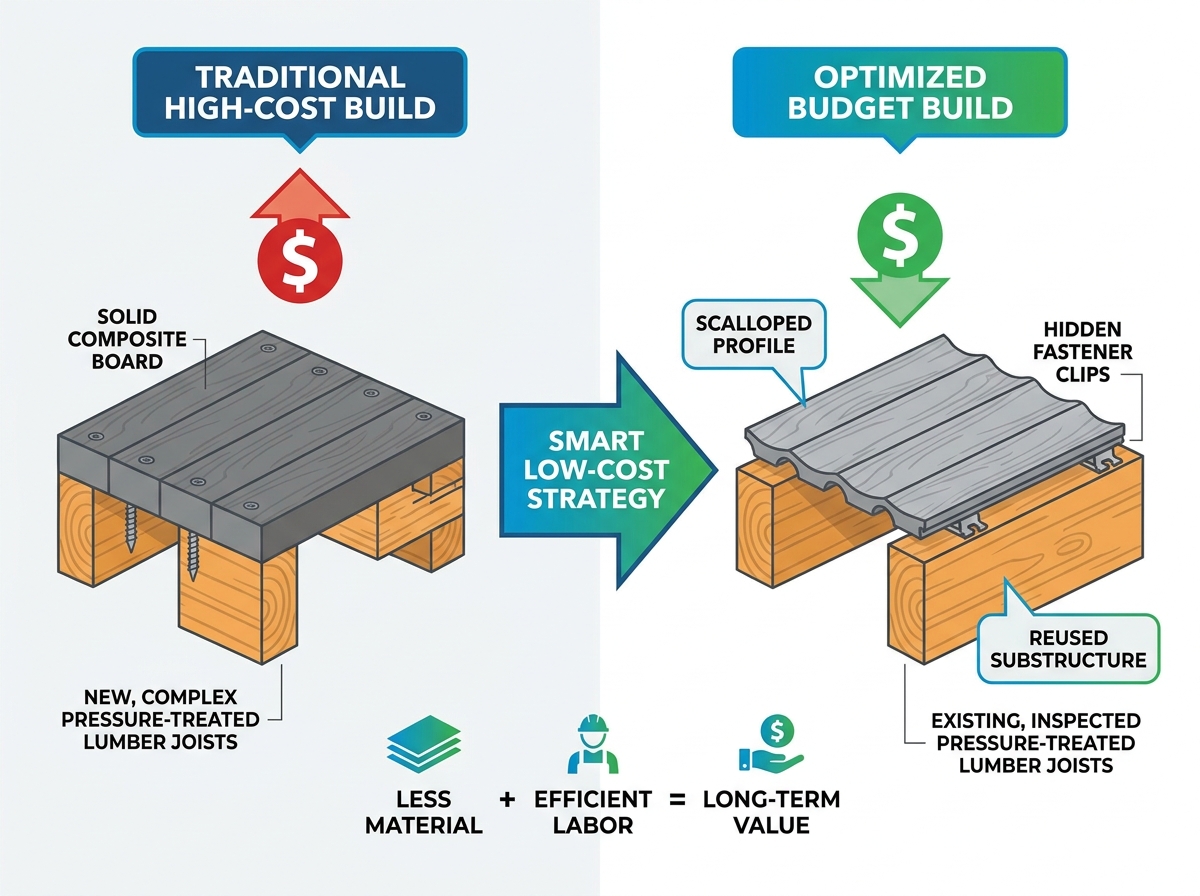
Understanding different board profiles saves serious money. We compare scalloped versus solid profiles extensively. Scalloped boards feature a uniquely grooved bottom. Manufacturers purposefully remove excess material underneath. They use much less raw material during production. This makes them the industry standard for budget-friendly applications. They maintain complete structural strength despite being lighter. You get identical surface aesthetics. You pay significantly less per linear foot. Scalloped designs represent pure engineering efficiency.
Next, position Wood-Plastic Composite as the superior budget choice. Many buyers confuse various synthetic material types. WPC is generally more affordable than 100% cellular PVC. It offers comparable durability for standard residential use. You receive excellent weather resistance all year round. Modern Composite Decking provides the best middle ground for homeowners. You avoid the premium price tag of solid PVC. You still escape the constant maintenance of traditional lumber.
We must strictly warn against buying ultra-cheap, first-generation uncapped composites. These outdated boards absorb moisture from rain and snow. They stain easily from spilled barbecue grease. They fade unevenly under direct sunlight exposure. We highly recommend 3-sided or 4-sided capped boards. Make this your non-negotiable baseline. Capped boards feature a specialized protective polymer shell. This shell ensures superior moisture resistance immediately. It guarantees long-lasting fade resistance. You gain incredible peace of mind knowing the core remains protected.
Inspecting and reusing an existing pressure-treated wood frame provides massive financial savings. It is the highest-impact cost-saving measure available today. However, implementation reality requires extremely strict safety checks. You must evaluate old joists carefully before proceeding. A compromised frame will ruin your new surface boards.
Conduct a thorough rot check around all old fastener holes.
Look closely for structural bowing across the unsupported spans.
Check the ledger board attachment against the house for water damage.
Ensure the foundation posts remain perfectly plumb and securely anchored.
Tap the joists to listen for hollow sounds indicating internal decay.
Optimizing joist spacing requires careful pre-planning. Industry standards normally dictate 16-inch on-center spacing. Some cheaper, thinner boards strictly require 12-inch spacing. Warn your contractor or DIY team about this crucial requirement. Calculate the extra lumber costs carefully beforehand. Cheaper boards often cost you more in extra substructure lumber. They need many more joists for adequate support. This hidden cost destroys many deck budgets.
Design the entire deck footprint around standard lengths. Manufacturers sell their boards in 12-foot, 16-foot, and 20-foot increments. Standardizing deck dimensions minimizes expensive off-cut waste entirely. You eliminate the need for complex breaker boards. If you build a 14-foot deck, you literally waste two feet per board. A 12-foot or 16-foot design eliminates scrap waste completely. You maximize every dollar spent on materials.
Preparation work represents the crucial DIY Phase 1. Demolition of the old deck takes considerable time. Leveling the site requires hard physical labor. Doing this before hiring a contractor saves significant billable hours. Contractors charge heavily for manual site clearing. You can complete these tasks easily over a weekend. You just need basic tools and some determination. Site prep requires no specialized carpentry skills.
Compare your fastening options carefully before starting. Face screws remain the absolute cheapest upfront option. However, we highly recommend purchasing universal hidden fasteners. They represent a moderate cost upgrade. Hidden clips provide substantially better long-term value. They preserve the structural safety of capped composites beautifully. Screwing directly through the cap exposes the inner wood-plastic core. Moisture can penetrate these tiny screw holes over time. Hidden fasteners keep the protective shell completely intact. They also create a flawless, barefoot-friendly surface.
Stick strictly to standardized board layouts. Choose simple horizontal or vertical installation patterns. We strongly warn against intricate herringbone designs. Picture framing looks beautiful but always wastes material. Diagonal patterns increase material waste by over fifteen percent. They also require tighter joist spacing for proper support. This tighter spacing demands substantially more framing lumber. Simple layouts keep your material budget completely under control. They also speed up the installation process immensely.
Compare big box retailers versus direct manufacturers carefully. Buying off-the-shelf at hardware stores offers immediate convenience. You find varying price tiers locally. However, buying direct from manufacturers often yields much better bulk pricing. Manufacturers ensure better batch consistency across large orders. Color matching remains vastly superior when buying direct. Big box stores sometimes mix pallets from different production runs. This mixing causes slight color variations on your deck.
Evaluate warranties on budget lines thoroughly. Read the manufacturer fine print carefully. A 15-to-25-year structural warranty on a budget board signals very strong trust. Brands stand firmly behind their manufacturing processes. Avoid any boards offering less than a 10-year guarantee. Short warranties clearly indicate low-quality filler materials. They suggest the capping layer might be too thin. Protect your investment by verifying the warranty terms before purchasing.
Take specific action steps before buying your materials.
Request physical samples for accurate color checking in natural sunlight.
Calculate your exact linear footage requirements based on your final blueprint.
Add a strict five percent contingency to account for standard cutting waste.
Secure multiple material quotes from different suppliers to compare final pricing.
Verify the delivery fees, as heavy pallets require specialized freight shipping.
Building a beautiful outdoor space on a strict budget remains entirely possible. "Low cost" should mean strategic efficiency, never cheap materials. We summarize the blueprint clearly for your project success. Buy scalloped decking profiles to reduce your upfront costs. Optimize the substructure using your existing healthy joists. Keep the overall deck design simple. Utilize smart DIY labor for demolition and prep tasks. These combined strategies save you thousands of dollars.
Take immediate action today to start your upcoming project. Order free board samples to compare different colors directly in your backyard. Use an online deck cost calculator to establish a realistic baseline budget. Contact the sales team for a custom material quote tailored specifically to your exact dimensions. Your dream deck awaits.
A: Yes, they offer excellent value if they are capped and structurally sound. Scalloped capped profiles provide great durability at a lower price point. However, you must actively avoid uncapped clearance boards. Uncapped materials absorb moisture, fade quickly, and degrade under harsh weather conditions. Always prioritize the protective polymer cap over finding the absolute lowest price tag.
A: You can reuse an open joist frame if the pressure-treated lumber remains completely rot-free. However, never lay composite materials directly over old surface decking boards. This traps moisture between the layers. The trapped moisture causes rapid rot. It completely voids most manufacturer warranties. Always remove the old surface boards first.
A: No. Scalloped boards utilize advanced structural engineering principles. Manufacturers design them specifically for standard 16-inch joist spans. They maintain excellent structural rigidity. They do not warp if you install them correctly. Always leave proper expansion gaps between the boards. These gaps easily accommodate normal thermal expansion during hot summer months.