Views: 0 Author: Site Editor Publish Time: 2026-07-21 Origin: Site


Transitioning from traditional wood to synthetic boards demands a high upfront investment. Standard marketing claims often muddy the waters. Brands promise endless perfection. However, the "best" board depends entirely on climate exposure, joist structure, and your specific budget. Brand recognition alone does not guarantee performance.
We cut through the noise to provide a contractor-grade, skeptical evaluation framework. This guide helps buyers align technical specifications directly alongside exact project realities. You will learn how to decode material compositions. We also expose hidden installation risks. Ultimately, you can confidently select the exact materials you need for a flawless build.
Material matters: Not all composites are equal; understanding the difference between standard WPC decking (Wood-Plastic Composite) and PVC/mineral-based cores prevents costly misapplications.
Heat and fading realities: Every composite deck gets hotter than natural wood in direct sunlight; mitigation requires specific color choices and advanced capping technology.
The tiered market: The industry operates on a "Good, Better, Best" model—paying for premium lines often buys better aesthetics and scratch resistance, not necessarily longer structural life.
Installation dictates performance: Even premium composite decking fails if contractor guidelines on joist spacing and expansion gaps are ignored.
Choosing the right materials requires looking beneath the surface. You must evaluate the core, the outer shell, and the physical shape of the boards. These elements dictate how the product performs over decades.
The interior makeup of your boards determines their vulnerability to moisture and heat. The industry relies on two primary formulations.
WPC Decking (Wood-Plastic Composite)
This remains the industry standard. Manufacturers blend recycled wood fibers and plastic polymers. You should analyze the ratio of these materials. Generally, a 50/50 blend offers a great balance of rigidity and weather resistance. It stands as the best choice for general use and budget-conscious builds. WPC decking delivers excellent stability across moderate climates.
Capped Polymer/PVC
These boards contain no organic material. They rely entirely on synthetic polymers. We highlight their superiority for water resistance. They remain ideal for pool surrounds and wet environments. Pure synthetic cores also dissipate heat much faster than wood-filled cores.
The protective outer layer, or cap, defends the core against the elements. You will typically choose between 3-sided and 4-sided capping.
3-Sided Capping: Covers the top and sides. The bottom remains exposed to allow moisture to escape. It works well for elevated decks.
4-Sided Capping: Wraps the entire board in a protective shell. This provides maximum protection against ground moisture.
The thickness and material of this cap dictate UV resistance. A high-quality cap provides essential stain protection. It also determines scratch mitigation. Thicker acrylic caps resist dog claws and moving furniture much better than standard polyethylene caps.
The physical shape of the board impacts how you handle and install it. It also changes how the deck feels underfoot.
Scalloped Boards: These feature grooved bottoms. They use less material, reducing both weight and cost. However, they may require tighter joist spacing to prevent sagging.
Solid Boards: These look like traditional lumber. Solid boards offer better structural rigidity. They also provide superior noise reduction. You will notice they feel much more solid underfoot.
Manufacturers segment their product lines into distinct tiers. Understanding this hierarchy helps you align expectations.
Market Tier Specifications and Trade-offs
Market Tier | Profile Style | Capping Type | Aesthetics |
|---|---|---|---|
Entry-Level (Good) | Scalloped | 3-Sided | Monochromatic, repeating grain |
Mid-Range (Better) | Solid | 4-Sided | Multi-tonal streaking |
Premium (Best) | Solid (PVC/Mineral) | Advanced Polymer | Hand-scraped, hyper-realistic |
Brands target these lines at budget replacements. They usually feature scalloped profiles and 3-sided capping. The color palettes remain largely monochromatic. They lack complex streaking.
Trade-off: You accept lower scratch resistance. The wood grain looks noticeably less realistic. They serve perfectly well for low-traffic backyard patios.
This tier represents the sweet spot for many homeowners. You get solid profiles and advanced 4-sided capping. The visuals improve drastically. They feature multi-tonal streaking for better aesthetics.
Trade-off: You deal with heavier boards. They demand slightly higher upfront costs per square foot. However, the upgraded scratch resistance usually justifies the upgrade.
These lines feature pure PVC or highly engineered mineral cores. Manufacturers focus on extreme heat dissipation and superior traction. You get complex, hand-scraped textures that mimic exotic hardwoods perfectly.
Trade-off: You face diminishing returns on structural longevity compared to the mid-range. You pay a premium strictly for aesthetics and extreme climate performance.
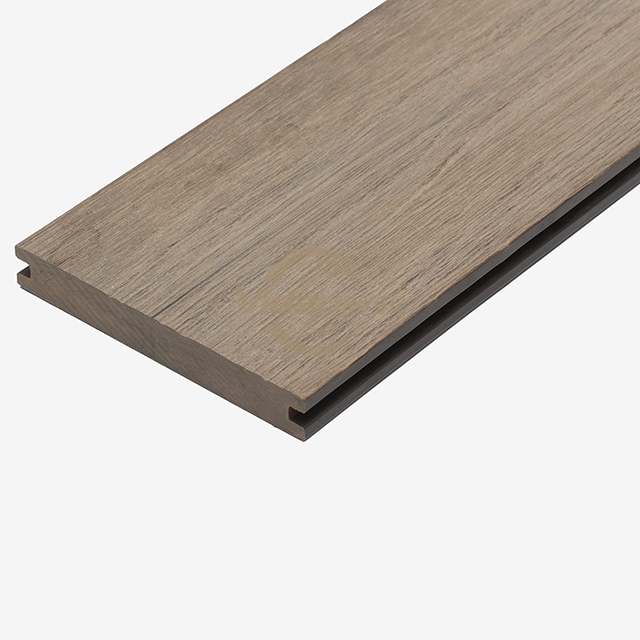
A beautiful board fails quickly in the wrong environment. You must match the material capabilities to your specific geographic and functional realities.
Direct sunlight pushes synthetic boards to their limits. They absorb and hold thermal energy.
Requirement: Focus on lighter color families. Choose PVC or mineral cores to mitigate heat retention. Light gray or pale tan boards reflect sunlight effectively.
Risk factor: Dark Composite Decking in direct sun reaches uncomfortable temperatures for bare feet. You can easily burn your skin on a dark brown board during a July heatwave.
Wet environments demand specific safety considerations. Slips and falls present major liabilities.
Requirement: Prioritize slip-resistance ratings. Look for ADA compliance standards if applicable to your commercial project. You must select 100% synthetic cores to prevent mold growth. Organic fibers in grooved boards absorb standing water, causing eventual degradation.
Public spaces and hot tub surrounds apply extreme point loads to decking structures.
Requirement: You need solid profile boards with high load-bearing ratings. Scalloped boards compress under heavy concentrated weight. You must enforce mandatory 12-inch on-center joist spacing. Standard 16-inch spacing allows too much flex under commercial traffic.
Premium materials guarantee nothing if installed poorly. Contractor errors ruin more decks than material defects.
Unlike wood, synthetic materials expand along their length when heated. They shrink when temperatures drop.
You must highlight the necessity of proper gapping. Installers must leave specific gaps at butt joints. Without them, expanding boards push against each other and warp. We highly recommend using breaker boards. A breaker board runs perpendicular to the main deck surface. It hides the expansion gaps and creates a much cleaner visual layout.
How you attach the boards impacts both aesthetics and maintenance.
Hidden Fasteners: They provide a flawlessly clean look. They clip into the grooves on the sides of the boards. However, they make replacing a single damaged board difficult. You often have to remove several adjacent boards to reach the damaged one.
Face Screws (Color-matched): These require solid boards. They offer a much better structural hold. Installers drive them straight through the top. They do visually interrupt the grain pattern, but they make single-board replacements incredibly easy.
Synthetic decking acts like a skin. It contours exactly to the framing beneath it. A wavy substructure results directly in a wavy deck.
Best Practice: Emphasize joist taping. Installers must apply butyl tape over the top of the wooden joists. The wood frame often rots decades before the synthetic surface fails. Protecting the substructure ensures the deck surface has a stable foundation for its entire lifespan.
You narrow down your options through rigorous testing and careful document review. Do not base your final decision on a glossy brochure.
You should physically abuse the samples before buying.
Order physical samples of your top three choices.
Leave them in direct sunlight for 4 hours to gauge heat retention.
Test them with a wet shoe. Press down and twist to check traction.
Scratch them aggressively with a house key. Observe how deeply the cap scratches.
Manufacturers write warranties to protect themselves. You must differentiate between "Structural Warranties" and "Fade & Stain Warranties." A structural warranty protects against rot and splintering. A fade warranty dictates how much color loss is acceptable.
Note the fine print regarding labor costs. Most warranties only cover material replacement. If a board fails, they ship you a new one. You still pay the contractor to rip up the old one and install the replacement.
Ensure your installer possesses certification from your specific brand. Improper installation voids the manufacturer’s warranty immediately. If they ignore gapping rules, you lose your coverage. Ask for proof of factory training before signing the contract.
The "best" composite decking relies entirely on a strict formula: Climate + Usage + Proper Substructure. You cannot isolate one variable. Lighter colors save bare feet in southern climates. Solid boards prevent flexing under hot tubs.
We encourage you to finalize the project budget by factoring in the entire system. Include hidden fastener systems and substructure remediation in your estimates. Looking only at the per-board cost leaves you vulnerable to massive budget overruns. Buy the right core, protect the frame, and enforce proper gapping for a flawless result.
A: Yes, darker WPC decking retains significant heat in direct sunlight. Dark brown or black boards can become uncomfortably hot to the touch. We highly recommend choosing lighter color families, such as gray or pale tan, for southern exposures. Alternatively, opt for PVC-core boards, as they dissipate heat much faster than wood-filled cores.
A: No. It is low-maintenance, not no-maintenance. You never have to sand, stain, or seal it. However, it still requires semi-annual washing. Pollen, dirt, and decaying leaves can accumulate on the surface. If left uncleaned, surface mold can grow on this organic debris.
A: You can, but only if the joists pass a strict inspection. The wood must be structurally sound, perfectly level, and entirely rot-free. Furthermore, they must be spaced correctly. Synthetics usually require a 16-inch on-center maximum spacing. If the old frame sags, the new deck will sag too.
A: Not if they are installed strictly to manufacturer specifications. Scalloped boards meet all residential building codes for load-bearing capacity when supported properly. However, they use less material. Consequently, they may feel slightly less rigid underfoot compared to premium solid boards.