Views: 0 Author: Site Editor Publish Time: 2026-07-22 Origin: Site


Coastal environments are notoriously aggressive on outdoor building materials. Elevated chloride levels from sea spray, constant airborne moisture, high wind shear, and intense UV exposure dramatically accelerate structural degradation. Property owners often discover natural timber decks demand frequent replacement cycles and intensive seasonal maintenance. These ongoing burdens drive up lifetime expenses significantly while causing endless frustration.
Our objective is to provide a transparent, criteria-driven framework for your next project. We will help you evaluate and select engineered boards capable of genuinely withstanding harsh marine-adjacent conditions. You will learn how different polymers handle corrosive salt spray, why substructure protection dictates overall longevity, and how to properly assess thermal retention in exposed gardens. By understanding these technical dynamics, you can confidently build a resilient, beautiful outdoor space tailored exactly to your unique coastal micro-climate.
Fully capped composite decking and PVC-based boards offer the highest resistance to saltwater swelling and structural degradation.
Coastal installations require specific hardware; using standard fasteners will result in rapid galvanic corrosion.
WPC decking retains more heat than light-colored timber; color selection is a functional decision, not just an aesthetic one.
The longevity of a coastal deck depends heavily on protecting the vulnerable treated-lumber substructure beneath the composite boards.
Airborne salt presents a relentless threat to any outdoor garden structure. Chloride crystals easily penetrate porous materials upon contact. They aggressively draw out natural moisture from traditional timber. This chemical process causes standard wood to dry out prematurely, splinter, and ultimately rot from the inside out. Standard stains and sealants struggle to combat this constant salt spray attack.
Hygroscopic expansion presents another major challenge for seaside properties. Coastal zones experience extreme humidity fluctuations and dense morning sea mist. These environmental factors force unsealed materials to absorb water. The boards expand and warp significantly as moisture enters their cellular structure. Daily temperature shifts then cause rapid contraction. This constant movement creates severe structural fatigue over a few short seasons.
High UV degradation also plagues oceanfront environments. Coastal areas typically register exceptionally high UV indexes. Intense solar radiation quickly strips vibrant color pigments from natural wood. More dangerously, UV rays break down the structural lignins found in timber. Lignins act as the natural binding agent holding wood cells together. When they degrade, the board quickly loses surface integrity and begins to flake.
Engineered boards successfully bypass these biological and chemical vulnerabilities. Manufacturers encapsulate recycled wood fibers within high-density synthetic polymers. This protective barrier fundamentally changes how the material interacts with the environment. It shields the vulnerable core from salt absorption and water infiltration. Highly specialized UV inhibitors mixed into the polymer also prevent significant color fading. This unique construction grants the boards incredible resilience against harsh seaside elements.
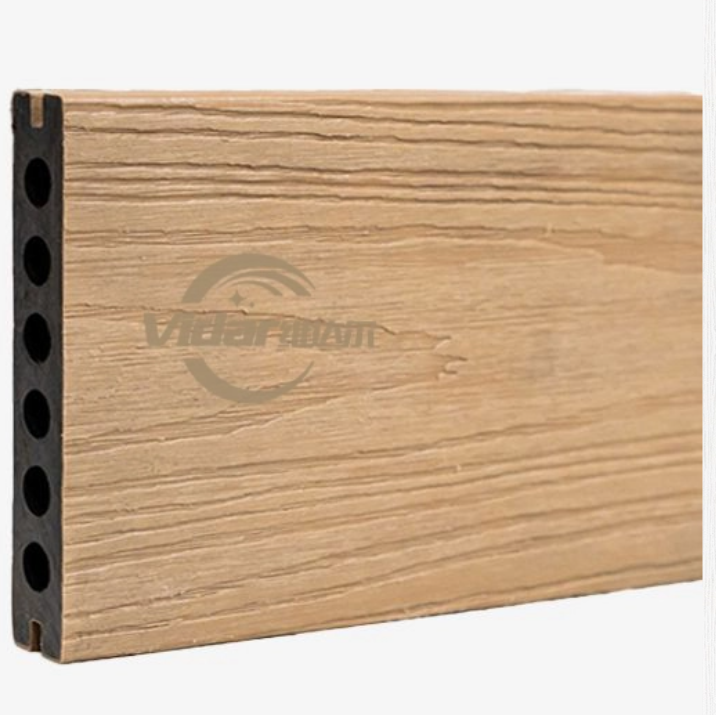
Not all synthetic boards perform equally in aggressive coastal climates. We must categorize these materials carefully to ensure long-term stability. The presence and quality of a protective polymer shell dictate overall performance.
First-generation boards feature a basic wood-plastic blend without an exterior shield. You will often see exposed wood fibers across the board surface. Installers rarely recommend this standard Composite Decking,WPC decking for direct coastal exposure. The exposed organic matter actively absorbs airborne moisture and salt spray. This absorption inevitably leads to stubborn mold growth, dimensional swelling, and structural degradation over time.
A fully capped Composite Decking profile provides a superior solution. Manufacturers encapsulate the inner core entirely within a protective polymer shield. The shield covers all four sides of the board. This specific category offers an excellent balance of upfront cost and long-term performance. The impermeable shell remains highly resistant to corrosive salt accumulation, accidental chemical staining, and persistent moisture penetration.
Advanced PVC lines represent the premium tier for extreme marine environments. These specific profiles contain absolutely zero wood fiber. Manufacturers construct them entirely from synthetic polymers and specialized mineral blends. They boast the highest possible resistance to water damage and organic decay. Because they lack organic material, they also weigh significantly less. These boards remain ideal for heavy-duty boardwalks, private jetties, or garden platforms positioned immediately on the shoreline.
Material Category | Wood Fiber Content | Salt Resistance | Ideal Coastal Application |
|---|---|---|---|
Uncapped WPC | High (Exposed) | Low | Inland use only |
Fully Capped WPC | Moderate (Encapsulated) | High | Elevated coastal gardens |
Mineral/PVC | Zero | Maximum | Direct beachfront & jetties |
Choosing the correct board requires looking beyond color and grain patterns. Coastal gardens demand rigorous technical evaluation. You must assess specific performance metrics to guarantee a safe, comfortable outdoor living space.
Coastal gardens experience heavy morning dew, frequent sea spray, and active pool splash. Smooth surfaces become dangerously slick under these conditions. You must evaluate boards based on standardized, independent slip tests. The Pendulum Test Value (PTV) serves as the industry gold standard for slip assessment. Look for boards achieving a high PTV rating in wet conditions. Deeply embossed, high-friction woodgrain textures provide the necessary grip to prevent accidents.
We must address a transparent assumption regarding synthetic materials. Engineered boards absorb and retain significantly more heat than natural wood. Dense polymers hold thermal mass. Direct summer sunlight can make dark boards uncomfortably hot for bare feet. You can mitigate this issue through smart selection. Filter your product choices by light-reflective colors. Ash greys, whitewashed oaks, and sandy tans reflect solar energy efficiently. Many premium brands also integrate advanced core technologies designed specifically for faster heat dissipation.
Temperature volatility characterizes many coastal micro-climates. These areas often experience rapid temperature drops. A garden baking under the midday sun cools abruptly when the cold evening ocean breeze arrives. This thermal shock causes dense materials to expand and contract rapidly. You must analyze the manufacturer's specific thermal expansion coefficients. Understanding this metric allows your installation team to calculate precise expansion gaps between boards.
Even the highest-grade polymer board will fail if installed poorly. The harsh seaside environment exploits any weakness in your construction method. You must mandate strict installation protocols to protect your investment.
Substandard hardware represents the most common failure point in coastal deck construction. Standard coated screws or 304 stainless steel fasteners will corrode rapidly in a salt-heavy environment. The chloride ions attack the metal alloy, causing aggressive rust. You must mandate marine-grade 316 stainless steel fasteners for the entire project. The added molybdenum in 316 stainless steel prevents chloride pitting. We also highly recommend utilizing hidden clip systems. These clips secure the boards without puncturing the top surface, thereby preventing moisture entry and ugly rust staining.
A premium board guaranteed for 25 years becomes completely useless if the framing rots away. Trapped moisture heavily damages treated pine substructures in coastal zones. Condensation gathers under the deck and sits on top of the wooden joists. You must specify butyl-based joist flashing tape for all timber framing. Installers apply this waterproof tape directly over the joists before laying the boards. The butyl adhesive actively self-heals around screw threads, completely sealing the wood against rot.
Exposed coastal gardens face severe storm zones and high wind shear. Improperly spaced boards trap air pressure underneath the deck structure. You must address proper gapping requirements carefully. Correct spacing accommodates necessary thermal expansion during hot days. It also guarantees efficient water drainage during heavy storms. Most importantly, adequate gaps allow high-pressure air to escape, actively preventing catastrophic wind-uplift during severe coastal squalls.
Using standard galvanized screws instead of marine-grade 316 stainless alloys.
Ignoring minimum ground clearance rules, which prevents essential cross-ventilation.
Failing to apply waterproof joist tape over the vulnerable timber framework.
Butting board ends tight together without calculating thermal expansion coefficients.
Manufacturer warranties vary wildly regarding coastal installations. You must read the fine print carefully before committing to a specific brand. Understanding warranty caveats ensures you remain fully protected.
Many standard warranties contain exclusionary clauses for oceanfront properties. Review exactly what specific conditions void a manufacturer’s coverage. Common exclusionary factors include proximity to saltwater, inadequate ground clearance, and improper cross-ventilation. High humidity environments require robust airflow beneath the deck. Look for comprehensive warranties explicitly covering "fade and stain" resistance alongside basic structural integrity. A robust warranty demonstrates the manufacturer's confidence in their polymer shield.
Your final selection should balance your budget against your proximity to the water. We recommend capped polymer boards in mid-tier ranges for elevated coastal gardens situated further back from the beach. They offer superb protection against occasional salt spray. Conversely, direct beachfront exposure demands the highest level of protection. Choose premium PVC or mineral-polymer lines for properties built directly on the sand. These lines guarantee the lowest long-term maintenance requirements.
Never purchase outdoor flooring based solely on digital photos. You must evaluate the material physically in your specific micro-climate. Order multiple physical samples of your shortlisted boards. Place them outside in your garden to test heat retention during peak sun exposure. Pour saltwater over them to observe how quickly they dry. Finally, walk on them while wet to verify the wet-slip resistance firsthand.
Successful coastal deck specification requires aligning the board's core material directly with the exact severity of your micro-climate. Advanced polymer encapsulation provides incredible defense against aggressive chloride attacks, UV degradation, and moisture swelling. However, remember that the highest-grade engineered boards will still underperform if paired with substandard fasteners or an unprotected timber frame.
Focus heavily on structural longevity by mandating 316 stainless steel hardware and butyl joist tape. Select light-colored, deeply embossed profiles to manage heat retention and ensure slip safety. We encourage you to utilize a dedicated decking cost calculator to plan your budget accurately. Order physical samples today or book a technical consultation to secure the perfect material for your oceanfront garden.
A: High-quality capped boards are highly resistant to salt damage. The protective polymer shell prevents moisture and chloride from penetrating the core. While salt residue can occasionally leave a white, chalky film on the surface, it will not cause structural rot like it does in natural timber. You simply need to perform occasional washing with fresh water and mild soap to maintain a pristine appearance.
A: Lighter colors are strongly recommended for harsh seaside environments. Light greys, whitewashed oaks, and sandy tans naturally reflect intense UV rays. This reflective quality significantly minimizes heat retention in exposed, unshaded coastal gardens. Dark colors absorb thermal energy rapidly, making the deck uncomfortably hot for bare feet during peak summer afternoons.
A: No. Adequate airflow remains critical to prevent moisture entrapment and structural failure. Manufacturer specifications typically require a strict minimum clearance over a properly drained sub-base to validate the warranty. This clearance, often around 150mm, ensures necessary cross-ventilation. Proper airflow keeps the substructure dry and allows the boards to regulate temperature efficiently.