Views: 0 Author: Site Editor Publish Time: 2026-07-26 Origin: Site


Manufacturers heavily market Composite Decking as a maintenance-free, warp-proof alternative to natural wood. Homeowners understandably expect an indestructible outdoor surface. You spend thousands on a backyard oasis. You assume it will remain perfectly flat for decades. Yet, home improvement forums frequently feature alarming photos. Users regularly post images of buckled, twisted, or sagging synthetic boards. This visual evidence creates serious confusion for buyers. Why do these supposedly advanced materials fail so publicly?
We need to separate intrinsic material flaws from poor construction practices. Often, the surface material takes the blame for underlying substructure decay. You must understand how weather impacts these engineered polymers. A premium board behaves very differently under stress compared to natural timber. Ignoring these differences guarantees project failure.
This article provides an evidence-based breakdown of why synthetic materials distort. You will learn exactly how thermal expansion forces act on plastics in outdoor environments. We will uncover the hidden culprits behind structural failure. Finally, we cover the precise criteria you must evaluate to ensure a lasting, warp-free installation.
Moisture vs. Heat: Unlike traditional wood, modern composite decking does not warp from moisture absorption, but it is susceptible to thermal expansion and contraction.
The Installation Factor: 90% of "warping" issues in WPC decking are actually buckling or sagging caused by improper joist spacing or insufficient expansion gaps.
Substructure Vulnerability: A composite deck is only as straight as the wooden frame beneath it; rotting wood joists are a primary culprit for surface-level distortion.
Smart Purchasing: Evaluating board profiles (solid vs. scalloped), capping technology, and structural warranties is critical for mitigating long-term risk.
Terminology matters greatly in construction. We must redefine what warping actually means. Traditional timber warps because it absorbs moisture unevenly. Wood is naturally porous. It takes in water during heavy rain. It dries out rapidly in the sun. This constant swelling and shrinking creates deep cups and twists. Synthetic boards combine plastic polymers and wood fibers. The modern manufacturing process completely encapsulates the organic fibers in plastic. This makes them highly moisture-resistant. True "warping" from water damage rarely happens here.
When synthetic boards distort, they usually buckle or sag. Buckling happens when boards push aggressively against each other. Sagging occurs when they droop downward between supporting joists. People commonly misuse the term "warping" for these distinct mechanical and thermal failures. Understanding this difference helps you diagnose the real problem.
Homeowners routinely post alarming photos on platforms like Reddit or Houzz. We must validate these genuine concerns. Yes, synthetic boards can distort terribly. However, they almost never distort on their own. They require a powerful external catalyst. Extreme heat stress combined with restricted movement causes instant buckling. Alternatively, an underlying structural failure pulls the entire surface out of alignment. The board simply reacts to poor environmental controls.
Physics dictates how outdoor materials behave. Plastic expands when exposed to heat. It contracts significantly when ambient temperatures drop. This natural movement remains completely unavoidable. If installers butt boards tightly against each other, pressure builds rapidly. They often push boards flush against fascia trim or brick walls. The material needs adequate room to grow. If deprived of space, it has nowhere to go but up. This upward release of kinetic pressure creates severe buckling.
Imagine a deck in direct summer sunlight. The surface temperature can exceed ambient air by forty degrees. This extreme heat softens the polymer matrix slightly. It forces the board to stretch lengthwise. Installers must calculate these gaps meticulously based on the weather at the time of construction.
Common Mistake: Contractors sometimes install boards tight during cold winter mornings. By mid-summer, the sun drastically heats the plastic. Massive expansion occurs. This causes instant and permanent buckling across the entire deck surface.
Engineers design these boards with specific load limits. They are noticeably heavier than natural cedar or pine. They are also considerably more flexible. Standard wooden joist spacing often uses 16-inch centers. However, some specific synthetic layouts require much tighter support networks. Diagonal board patterns typically demand 12-inch centers. Commercial applications might require even closer spacing.
If you space supports too far apart, major problems arise. The material will eventually sag under its own weight. Heavy foot traffic and large patio furniture accelerate this ugly drooping effect. Once a board sags between widely spaced joists, it rarely recovers its original flat profile.
We must highlight the most common hidden issue. Homeowners often place new 25-year premium boards over old wooden frames. Those treated pine joists might already be a decade old. Moisture trapped under the deck accelerates fungal growth. Wood decay fungi consume the cellulose in the timber joists. The joist loses its structural integrity. It twists and sags downward into the earth.
The sinking frame acts as an anchor. It pulls the top layer down aggressively. The incredibly stiff composite board attached to it is forced to follow this downward curve. You might look at the surface and blame the modern plastic material. In reality, the traditional wood foundation failed completely. A premium surface cannot fix a rotting foundation.
Mechanical installation errors frequently destroy perfect decks. Using the wrong screws causes immense localized stress. Many builders lock boards down tightly without using approved hidden fasteners. Traditional face-screwing traps the board in place. The material cannot move horizontally during major temperature shifts.
The trapped thermal energy forces the material to distort vertically. When builders secure these materials using incorrect screws, they create immense stress points. The board wants to expand. The screw prevents it. The pent-up energy forces the board to buckle upward near the fastener.
Best Practice: Always use the manufacturer-approved hidden clip systems. These clips secure the board vertically while allowing horizontal glide. They accommodate the natural breathing of the deck perfectly.
Early 2000s synthetic boards earned a notoriously terrible reputation. They sagged under minor weight and faded rapidly. Manufacturers used completely uncapped designs during this era. They blended unbalanced wood-to-plastic ratios. They mixed recycled plastic grocery bags with waste wood sawdust. They extruded this crude mixture directly into a board shape.
Because they left the outer surface uncapped, wood fibers remained exposed. These microscopic fibers acted like sponges. They absorbed rain, morning dew, and snowmelt. The subsequent swelling ripped the plastic matrix apart. Poor UV resistance left them highly vulnerable to extreme sun. The industry learned hard lessons from these early failures.
Today, co-extruded technology completely dominates the market. We call this modern innovation capped decking. A specialized manufacturing process wraps a protective, heavy-duty polymer shell around the inner core. This dense shell adds crucial structural rigidity. It severely limits any moisture intrusion. This advanced engineering dramatically reduces long-term distortion risks. The core remains completely protected from the elements.
Let us view this through a material science lens. We must compare basic wood-plastic materials to pure PVC alternatives. PVC consists entirely of synthetic plastics. It absorbs absolutely zero moisture. However, pure PVC possesses a noticeably higher thermal expansion coefficient. It grows much more under extreme afternoon heat. Therefore, precision installation gaps become incredibly critical for PVC. WPC offers a more stable middle ground regarding thermal movement.
Decking Material Evolution Chart
Material Generation | Composition Profile | Moisture Resistance | Warping/Buckling Risk |
|---|---|---|---|
First-Generation WPC | Uncapped, exposed wood fibers, basic plastics | Low (Prone to swelling) | High (Due to moisture absorption) |
Modern Capped WPC | Co-extruded polymer shell over robust core | Excellent (Nearly zero intrusion) | Low (Requires correct gap spacing) |
Pure PVC Decking | 100% synthetic polymers, zero wood | Absolute (Waterproof) | Moderate (High thermal expansion rates) |
When buying Composite Decking,WPC decking, you must evaluate structural profiles carefully. Not all boards deliver the same structural integrity. You need to know what you are paying for.
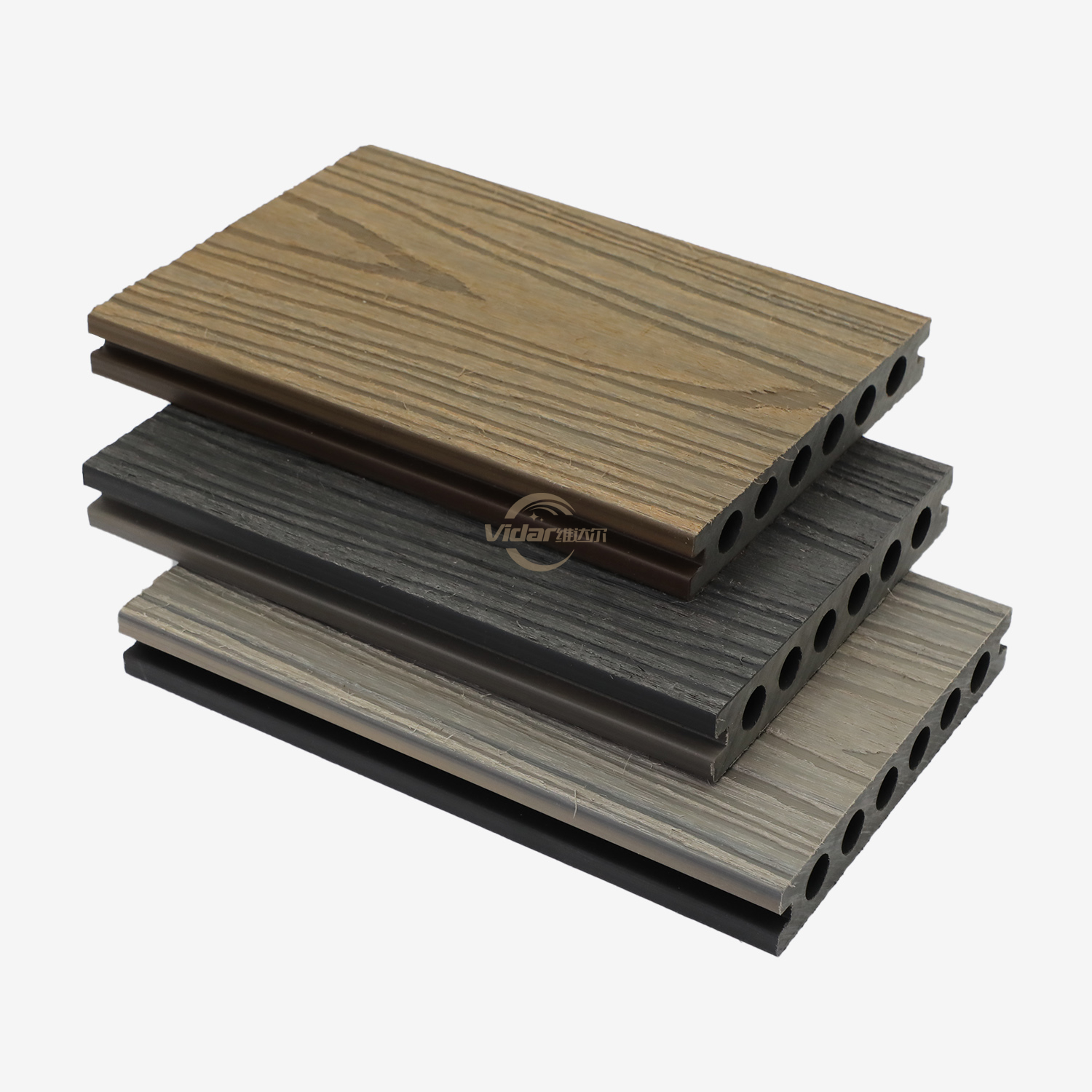
You must understand the distinct difference in board shapes. Scalloped boards feature a uniquely grooved bottom. Manufacturers remove material from the underside to save weight during extrusion. They use less raw material overall. This makes them significantly lighter and more cost-effective to ship and purchase. However, you must strictly follow joist spacing rules. They sag easily if left unsupported over long spans. They can feel slightly hollow beneath hard-heeled shoes.
Solid boards mimic natural timber's classic integrity. They feature a full, dense core without hollow channels. They offer superior rigidity and feel much firmer underfoot. Solid boards provide superior sound dampening. Dropping a heavy grill grate on a solid board rarely causes structural damage. They resist sagging much better than their scalloped counterparts.
Look far beyond the bold marketing text on the brochure. Read the actual legal terms of the warranty. Check if they explicitly cover structural deformation or just surface fading. Many warranties mandate highly specific installation methods. You might need to apply protective joist tape on every wooden beam. They might require proprietary hidden fasteners for coverage validity. Ignoring these strict rules instantly voids your financial protection. Ensure you understand every single exclusion listed in the document.
We strongly advise buyers to ask for the manufacturer's technical specification sheet. Look closely at the published thermal expansion numbers. Lower numbers indicate much better dimensional stability. Stable boards handle severe temperature swings without buckling. They stretch less in July and shrink less in January. Compare these numbers across three different brands before making a final purchasing decision.
A flawless deck requires flawless execution. You cannot cut corners during the foundational phases.
You need a rigorous checklist before beginning installation. Ensure contractors explicitly calculate expansion gaps. They must base these gaps on the ambient temperature at the precise time of installation. A board installed at 40 degrees needs a much larger gap than a board installed at 90 degrees.
Installation Vetting Checklist:
Ask how they determine end-to-end gap spacing during varying weather conditions.
Verify they use the correct proprietary fastening clips specified by the manufacturer.
Confirm they check the existing wooden joists for levelness using a long straight edge.
Ensure they do not overdrive screws directly into the board edges.
We highly recommend using joist flashing tape. It offers an incredible return on investment. The butyl tape blocks rain moisture from rotting the wood beneath. You apply it directly over the top edge of every wooden joist before laying the deck boards. This simple, inexpensive step effectively doubles the lifespan of your timber frame. It prevents the frame from sagging and pulling your new surface down with it.
We must outline the harsh reality here. A severely buckled plastic board cannot be easily fixed. You cannot flatten it out like wet wood. The plastic polymers have stretched permanently due to heat stress.
Steps to take for remediation:
Relieve the immediate pressure by carefully trimming the tight board ends using a circular saw or oscillating tool.
Remove the compromised surface layer to visually inspect the wooden substructure below.
Replace any rotting, twisted, or failing wooden joists beneath the surface.
Swap out the permanently damaged plastic pieces for fresh replacement boards. Ensure proper gaps this time.
We can summarize the final verdict clearly. Engineered synthetic flooring provides an objectively superior, low-maintenance outdoor surface. It vastly outperforms traditional wood over time. However, this holds true only if you respect its physical properties. It moves with the heat. It relies entirely on the structural frame built below it. It demands exact spacing.
We must reiterate a critical point. Investing in premium synthetic boards must be paired with rigorous execution. You need strict, by-the-book installation methods. You absolutely must build a protected, rock-solid substructure. This deliberate combination ensures a permanently flat, safe, and beautiful outdoor living space.
Take the correct next steps today. Request technical specification sheets from your chosen manufacturers. Consult with a certified, brand-approved installer who understands thermal movement. Finally, order high-density board samples to test their rigidity and quality yourself.
A: Heat causes WPC decking to expand. If proper spacing wasn't left during installation to accommodate this expansion, the heat will cause the boards to buckle and warp. Heat alone, with proper gapping, will not ruin the board.
A: They are more susceptible to sagging if joist spacing guidelines are ignored, but they do not inherently warp faster if installed correctly.
A: No. Unlike wood, which can sometimes be flattened by adjusting moisture, a composite board that has been permanently bent out of shape by heat stress and mechanical pressure must be replaced.
A: Darker boards absorb more UV heat, leading to slightly higher thermal expansion. While they won't inherently warp more, the installation gaps must be meticulously calculated to account for this extra heat absorption.