Views: 0 Author: Site Editor Publish Time: 2026-07-08 Origin: Site


Commercial buyers and contractors often face a psychological hurdle when designing elevated decks. Supporting thousands of pounds of heavy concrete, structural porcelain, or natural stone on "plastic" components feels entirely counterintuitive. You might wonder if polymer systems can truly handle commercial stress. However, modern construction demands balancing rapid, adjustable elevation for drainage and utility access with strict load-bearing safety requirements. Traditional mortar beds add massive dead weight and complicate subsurface repairs. The solution lies in highly engineered polymer systems. A high-quality adjustable plastic pedestal is specifically designed for elite structural performance. It relies on advanced material science and calculated geometry rather than sheer mass. We will explore how these high-density systems distribute immense weights safely across sensitive roof membranes. You will learn the mechanics behind their strength, how to accurately evaluate load capacities, and the necessary implementation realities required for flawless heavy-duty paving projects.
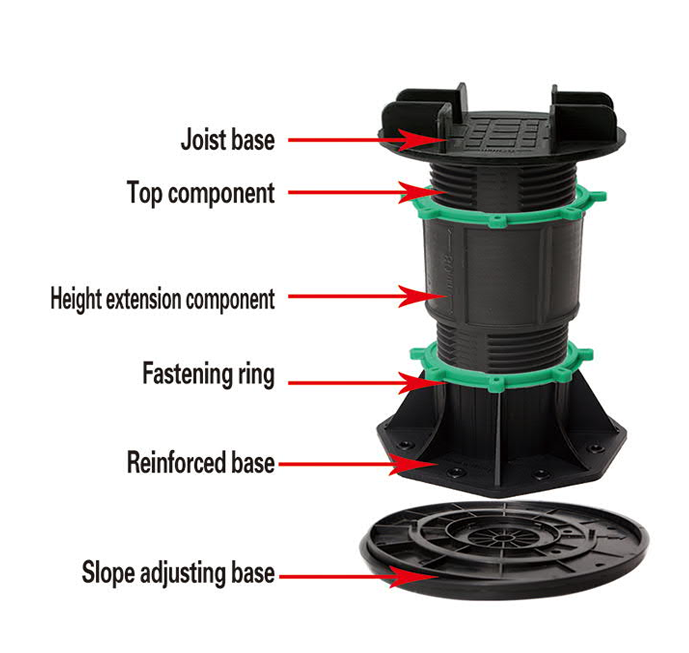
We must first examine the core material characteristics. High-Density Polypropylene (HDPP) forms the durable backbone of commercial paving supports. It boasts immense compressive strength. This specialized, reinforced polymer resists aggressive freeze-thaw cycles effortlessly. It remains completely immune to rot, rust, and chemical degradation. Engineers choose it specifically for harsh outdoor commercial environments. The molecular structure of HDPP creates a rigid yet slightly flexible matrix. It absorbs minor impacts without cracking.
Now consider the structural geometry. A cylindrical, threaded design works wonders here. It transfers vertical loads directly downward toward the base. You do not see harmful lateral shear stress developing within the column. The wide base and thick central core operate exactly like a structural building column. They guide heavy forces straight into the rigid substructure. This intelligent geometry maximizes strength while minimizing physical weight.
When verifying High load pedestal support, buyers must demand manufacturer limits based on standardized compression tests. Look for verified ASTM standard testing. You must clearly differentiate between two distinct load metrics. The ultimate failure load marks the point where a unit physically crushes. Conversely, the recommended safe working load involves a strict safety factor. Usually, reputable manufacturers divide the failure load by two or three. This conservative approach creates a massive safety margin for your architectural projects. It ensures long-term stability even under unexpected stress.
Understanding real-world load dynamics ensures total structural safety. We must first calculate the static dead loads. This includes the permanent weight of your chosen surface material. For example, two-inch concrete pavers weigh significantly more than 3/4-inch structural porcelain tiles. Concrete can exceed 24 pounds per square foot. You must map these permanent weights accurately across your grid. Accurate mapping prevents localized overloading.
Next, account for unpredictable live loads. These introduce dynamic, shifting weight into the engineering equation. High pedestrian traffic creates localized stress as crowds gather. Heavy planters and large commercial furniture add concentrated weight to specific zones. Localized impacts test the immediate resilience of the support base. Dropped maintenance equipment or moving carts require the system to absorb sudden shocks. A robust support system handles these active variables without buckling.
Wind uplift and lateral stability present another critical challenge. Heavy-duty rooftop tile applications risk lateral movement during severe storms. Heavy pavers work synergistically with elevated supports here. Their combined mass anchors the entire system. They prevent aggressive wind uplift from dislodging the surface. However, you must always lock the perimeter. When installing open-joint systems, perimeter containment is mandatory. It stops the entire paver matrix from shifting laterally under extreme load. A tightly contained grid behaves as a single unified structure.
Contractors have multiple ways to support heavy outdoor surfaces. Let us evaluate how an Adjustable paving pedestal compares to traditional alternatives. Understanding these differences drives better architectural decisions.
First, we contrast plastic systems against traditional mortar or aggregate beds. Plastic systems drastically reduce the overall structural dead weight. This reduction saves massive structural costs. They allow immediate water drainage through open surface joints. You face zero curing time during installation. They also allow incredibly easy access to sub-surface roof decks. Maintenance teams can lift a paver, repair a leak, and replace the paver instantly.
Traditional mortar creates immense dead weight on roof structures. It requires complex slope building to manage water flow properly. Curing mortar significantly delays your project timeline. If a leak occurs below the mortar surface, repairing it becomes extremely difficult. Crews must destroy the surface just to find the issue.
Next, consider plastic versus steel units. Plastic supports are entirely corrosion-proof. They naturally insulate against temperature transfer from the hot paving down to the sensitive roof deck. They also remain highly cost-effective across large commercial grids. Steel units offer a higher raw load capacity. However, they remain highly susceptible to rust over time. Even galvanized steel degrades in wet, outdoor environments. They also carry a significantly higher unit cost per square foot.
We provide a comparative decision matrix chart below. It outlines these core operational differences clearly.
| Evaluation Feature | Plastic Supports (HDPP) | Traditional Mortar | Steel Supports |
|---|---|---|---|
| Dead Weight Contribution | Extremely Low | Very High | Moderate |
| Water Drainage | Immediate / Open Joint | Requires surface sloping | Immediate / Open Joint |
| Corrosion Resistance | Excellent (Immune) | N/A | Poor (Unless specialized) |
| Sub-surface Access | Fast and Non-destructive | Destructive tear-out | Fast and Non-destructive |
When specifying these options, plastic fits roughly 90% of standard commercial rooftops and elevated plazas. You should only specify steel or concrete beds when highly unique structural codes mandate them.
Selecting the right heavy-duty system requires rigorous technical evaluation. We strongly recommend focusing on four essential criteria before purchasing.
First, evaluate the thread thickness and locking mechanisms. Examine the screw-jack mechanism closely. Thick threads prevent slipping when placed under heavy structural loads. Thin threads often strip under immense pressure. You also need dedicated locking rings. These rings prevent the threaded core from unwinding over time. Continuous micro-vibrations from foot traffic can slowly lower unprotected units. A locking ring secures the height permanently.
Second, review the base diameter and weight distribution. A wider base is absolutely critical for project success. A high-quality base typically measures 8 inches or more in diameter. This broad footprint reduces the point-load pressure (PSI). Lower pressure protects sensitive roofing membranes and soft insulation from crushing. A narrow base acts like a knife under heavy loads.
Third, comprehensively assess slope correction capabilities. Built-in or add-on slope correctors are non-negotiable for rooftops. Base or head levelers maintain a perfectly vertical load transfer on pitched roofs. They easily adjust for standard drainage gradients up to 5% or 10%. Vertical alignment ensures the surface weight travels directly down the central column. If the unit tilts, dangerous shear forces can cause structural failure.
Finally, demand verified third-party evidence. Instruct your procurement team to request independent laboratory test reports. You need verified data for maximum load capacity. Ask for UV degradation test results to ensure longevity. Require extreme temperature performance metrics before finalizing any procurement. Never rely solely on internal marketing brochures for structural components.
Even the finest support systems fail if installed incorrectly. Substrate integrity dictates overall deck success. A support unit is only as strong as the surface below it. Placing units directly on soft rigid insulation poses massive structural risks. Over time, heavy pavers will push the base deep into the insulation. You must use protective protection boards or dedicated load-distribution plates.
Below is a table highlighting common substrate protection requirements to guarantee long-term stability.
| Substrate Type | Primary Risk | Required Protection Component |
|---|---|---|
| Single-Ply Membrane (TPO/PVC) | Puncture from plastic edges | EPDM shim or rubber base pad |
| Rigid Foam Insulation | Crushing under point load | Load-distribution plate |
| Bare Concrete Deck | Minor acoustic transmission | Acoustic base pad (optional) |
Waterproofing membrane protection remains equally vital. You must deploy high-quality rubber base pads under the units. Thick EPDM shims also work incredibly well here. They prevent friction damage between the hard plastic base and the delicate roof membrane below. Skipping this protective step frequently voids expensive commercial roof warranties.
Contractors must also respect height-to-width ratio limits. Structural stability drops off sharply when you extend systems to extreme heights. Pushing units above 24 inches requires careful planning.
Follow these precise steps when facing extreme height requirements:
Engineered polymer supports remain an industry standard for heavy elevated paving. They perform flawlessly provided they are genuine commercial-grade units. HDPP delivers incredible compressive strength while avoiding the destructive dead weight of traditional mortar.
You must verify your sub-base capacity carefully before starting construction. Always calculate the maximum combined dead and live loads across your deck. Require verified ASTM test data from your supplier. Most importantly, ensure the base diameter offers adequate distribution protection for your specific waterproofing membrane.
Your next step is simple and actionable. Order a physical sample kit from your manufacturer. Inspect the thread thickness and base rigidity firsthand. Alternatively, consult directly with a structural engineer. They can run project-specific load calculations to guarantee safety, compliance, and long-term performance.
A: High-grade HDPP experiences progressive failure rather than instantaneous snapping. You will notice threading distortion before any catastrophic collapse occurs. Furthermore, standard redundant grid layouts prevent isolated unit failures from causing a complete surface collapse. The surrounding units absorb the displaced weight safely.
A: Standard plastic models are strictly for pedestrian applications. Do not use them for cars. However, highly specialized ultra-dense systems do exist for light vehicular loads. These robust setups usually require complex sub-structures and specific engineering approvals.
A: When manufactured with proper UV protection and installed correctly, they often last over 20 years. In fact, commercial-grade polymer supports typically outlast the actual waterproofing membrane located beneath them.
A: Thermal expansion and contraction do occur in polymers. Extreme heat can slightly soften plastics. However, high-grade polypropylene is specifically engineered to maintain structural integrity and safe working loads well beyond standard outdoor temperature ranges.