Views: 0 Author: Site Editor Publish Time: 2026-07-04 Origin: Site


Commercial landscape architects face a persistent challenge. They must balance aesthetic appeal, structural durability, and spatial efficiency in high-traffic commercial spaces. Finding the exact material often feels like an impossible compromise. Natural wood offers a warm, biophilic aesthetic but suffers from moisture damage over time. Conversely, industrial materials like concrete provide immense durability but introduce extreme weight and rigid visual profiles. Facility managers constantly seek better solutions to optimize their outdoor environments.
We introduce Wood Plastic Composite (WPC) as a highly compelling alternative. It effectively bridges the gap between natural wood aesthetics and industrial-grade resilience. Designers increasingly turn to this composite blend to meet rigorous project demands without sacrificing visual warmth. Our objective here is clear. We objectively evaluate whether these composite containers meet the strict performance, spatial, and installation requirements of commercial deployments. By examining material durability, spatial strategies, and procurement standards, you will discover how these modern planters perform in real-world applications.
Urban commercial spaces demand smart traffic routing and efficient space division. A Rectangular WPC planter acts as a natural, unobtrusive barrier. Facility managers use linear profiles to guide pedestrians away from restricted zones. Hospitality venues deploy them to enclose outdoor dining patios seamlessly. Corporate plazas utilize these straight-edged containers to establish clear walkways. They achieve secure zoning without relying on aggressive metal fencing or heavy masonry.
Modularity presents another massive advantage for modern architectural blueprints. You can align straight-edged planters side-by-side to create continuous greenery. This supports biophilic design principles in contemporary workspaces. Designers avoid the hassle of custom-built masonry walls. Instead, they drop these modular units directly onto finished surfaces. If spatial needs change, maintenance teams easily reconfigure the layout. This flexibility remains vital for dynamic retail environments and adaptive corporate campuses.
Volume-to-footprint efficiency cannot be overstated in premium real estate. Commercial properties measure value by the square foot. Standard round planters waste critical corner space and floor area. Rectangular designs maximize soil volume while minimizing footprint loss. They provide the deep soil capacity required for tall privacy screens. Landscapers easily plant bamboo, ornamental grasses, or dense ficus hedges. The roots gain sufficient room to spread, ensuring plant health while preserving valuable pedestrian pathways.
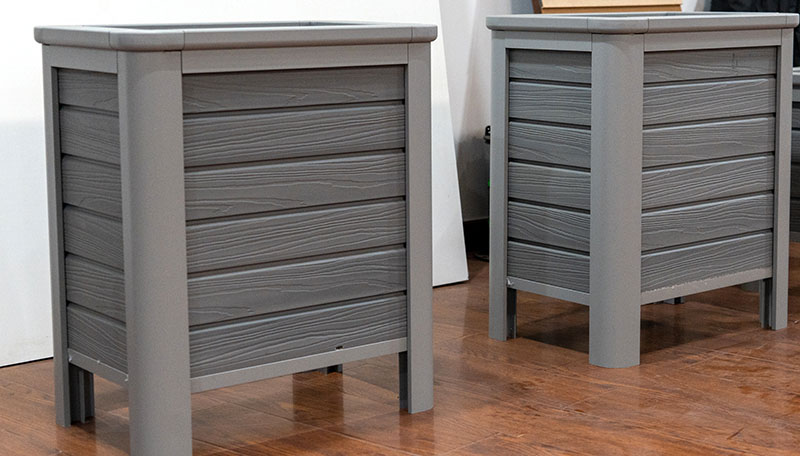
Durability defines success in public spaces. A commercial-grade WPC flower pot relies on a dense plastic-polymer matrix. This specific blend protects the container against daily physical abuse. Landscaping equipment often bumps into planters during routine maintenance. Pedestrians drag bags or kick edges in crowded plazas. The polymer shields the wood fibers from chipping or splintering. We observe fewer scuff marks on composite surfaces compared to painted metals or softwoods.
Moisture and rot realities dictate material choices for outdoor landscaping. Natural timber eventually succumbs to water saturation. Wood warps, rots, and invites pest infestations. WPC boasts near-zero rot properties. The plastic encapsulates the organic fibers, blocking moisture absorption entirely. This characteristic makes composite planters exceptionally suitable for automated commercial irrigation systems. Drip lines run continuously without threatening the container's structural integrity.
We must take a skeptical look at thermal expansion and warping risks. Temperature fluctuations affect all composite materials. Extreme heat can cause unsupported plastic to bow outwards. Commercial buyers should follow specific evaluation criteria when selecting units.
Commercial rooftops and elevated decks operate under strict structural load constraints. Dead weight calculations determine project viability. Concrete containers often exceed safe bearing limits once filled with wet soil. WPC offers a safer, mid-weight alternative. It remains heavy enough to resist high winds on exposed terraces. Yet, it weighs significantly less than cast concrete. While single-wall fiberglass is lighter, it often lacks the visual substance required for premium architectural designs.
Aesthetic longevity requires careful expectation management. You must address the patina effect inherent to composite materials. Premium WPC mimics natural wood grain beautifully. It ages much more naturally than chipped or scratched fiberglass. However, the organic wood fibers will undergo an initial weathering phase. You should expect slight UV-induced color lightening over the first six months. Once stabilized, the color holds steady for years. Fiberglass, conversely, relies on applied paint. When fiberglass scratches, the stark white resin beneath becomes glaringly obvious.
To clarify these structural and aesthetic differences, we summarized the comparison across core metrics below.
Commercial Material Comparison Overview
| Material Type | Relative Dead Weight | Aesthetic Longevity | Wind Resistance (Empty) |
|---|---|---|---|
| Wood Plastic Composite (WPC) | Moderate | Natural fade; masks scratches well | High |
| Commercial Fiberglass | Lightweight | Paint chips expose raw resin | Low (Requires anchoring) |
| Cast Concrete | Extremely Heavy | Develops heavy patina/moss | Maximum |
Corporate sustainability mandates strongly influence procurement decisions today. Sourcing environmentally responsible materials is no longer optional. A WPC garden flower pot perfectly aligns with these modern Environmental, Social, and Governance (ESG) goals. Manufacturers blend reclaimed wood fibers and recycled industrial polymers. This process diverts massive amounts of waste from local landfills. Companies proudly showcase these installations to highlight their commitment to sustainable site development.
These material choices contribute directly to green building certifications. LEED (Leadership in Energy and Environmental Design) awards points for using recycled materials. Integrating composite planters into your landscape plan supports Materials and Resources (MR) credits. They also assist in Sustainable Sites (SS) categories when used to manage stormwater or host native vegetation. Architects explicitly specify composite solutions to hit these stringent certification targets.
We must also evaluate the end-of-life lifecycle. A standard commercial cycle lasts roughly ten years. When fiberglass planters reach their end, the epoxy-based resin complicates recycling. They mostly end up in landfills. Conversely, many advanced WPC blends retain their thermoplastic properties. Specialized recycling facilities can melt down and repurpose clean composite material. This creates a much smaller disposal footprint, reinforcing a circular economy model for landscape architecture.
Improper drainage setup remains the number one point of failure for large commercial planters. Waterlogging kills expensive plant inventory rapidly. Root rot destroys root systems within weeks if water cannot escape the container. You must outline strict requirements for commercial installations. Elevated bases keep the container off direct pavement. Generous drainage holes prevent internal pooling. Commercial-grade permeable liners stop fine soil from clogging those escape routes over time.
Anchoring and security present another major implementation risk. High-wind zones demand careful planning. While WPC possesses moderate weight, extreme gusts can shift unanchored containers. Public areas also face vandalism and theft threats. Installers routinely bolt the internal base of the planter directly into the concrete sub-floor. Alternatively, they add hidden weighted ballast beneath the false bottom. This secures the unit permanently without compromising the exterior visual profile.
Facilities management teams require realistic cleaning protocols. Complex maintenance schedules fail in the real world. Composite materials forgive many common errors, but strict guidelines ensure longevity.
Procuring materials for large-scale landscaping requires strict vetting. You cannot rely on residential-grade specifications for commercial deployments. Wall thickness serves as your primary metric. Large rectangular designs face immense outward pressure from wet soil. You must demand minimum thickness standards from manufacturers. Thin walls bow, warp, and eventually snap under seasonal freeze-thaw cycles. Request engineering documents detailing internal bracing frameworks. Reliable units utilize hidden metal or heavy-duty plastic cross-ties.
Warranty provisions distinguish reliable partners from risky vendors. A standard residential warranty rarely covers commercial abuse. You need compliance documents addressing structural failure and abnormal UV fading. Standard wear and tear are naturally excluded. However, splitting at the seams or premature material crumbling should be fully covered. Review the fine print regarding irrigation exposure. Some poor-quality manufacturers void warranties if internal irrigation systems are installed.
Evaluate your vendor’s supply chain capacity before finalizing blueprints. Bulk shipping logistics require specialized handling. Customization capabilities often seal the deal. Architects frequently require bespoke dimension capabilities to fit precise alcoves. They also need custom RAL color matching to align with corporate branding. Ask these specific questions during the bidding process.
Rectangular WPC planters prove highly suitable for demanding commercial projects. They succeed provided you source them from commercial-grade manufacturers who utilize adequate structural bracing. These composite containers solve the historic dilemma between natural aesthetics and long-term durability.
We highly recommend these planters for environments prioritizing natural aesthetics, moderate weight restrictions, and low ongoing maintenance. Architects, facility managers, and B2B buyers should take immediate action. Request a physical material sample to evaluate the wood grain texture. Review the technical specification sheets to confirm internal bracing. Finally, schedule a consultation with a certified manufacturer to discuss bulk project pricing and custom dimension capabilities.
A: Yes, they undergo a brief initial weathering phase. The organic wood fibers lighten slightly during the first few months of direct sunlight exposure. However, commercial-grade composite includes premium UV inhibitors. These chemical stabilizers halt the fading process quickly. The color remains stable and consistent for years without needing stains or sealants.
A: Absolutely. They handle freeze-thaw cycles exceptionally well. Unlike terracotta or solid concrete, the plastic matrix prevents deep moisture absorption. Because the material does not absorb water, it will not expand and crack when temperatures drop below freezing. You simply must ensure proper soil drainage continues functioning.
A: Yes, the manufacturing process allows for significant customization. The extrusion and assembly methods make adjusting lengths and heights highly feasible. You can match precise spatial requirements easily. Be aware, however, that requesting entirely non-standard molds may extend your procurement lead times.
A: It varies by dimension, but calculation is straightforward. You add the container's tare weight to the saturated soil weight. Wet commercial potting soil weighs approximately 100 pounds per cubic foot. Multiply your planter's internal cubic volume by 100, then add the empty WPC weight. This gives structural engineers the maximum load-bearing figure.