Views: 0 Author: Site Editor Publish Time: 2026-06-30 Origin: Site


Traditional commercial construction harbors a noticeable bias. Developers routinely default to solid decking for high-traffic zones. They often assume hollow boards lack the necessary structural integrity for demanding environments.
This bias creates genuine tension across major commercial projects. Think about hotel terraces, busy restaurant patios, and sprawling public boardwalks. You must constantly balance material weight, upfront budgets, and long-term durability. Heavy materials strain underlying substructures. They also push project costs significantly higher during installation.
Square-hollow boards undeniably present real crushing risks in heavy-duty commercial settings. However, modern manufacturing advancements have fundamentally shifted this landscape. Specifically, round-hole architectures combined through co-extrusion technology rewrite the performance rules for WPC decking entirely. Readers will learn how to evaluate these modern boards, balance structural loads effectively, and mitigate installation risks safely.
Traditional square-hole **hollow WPC decking** is generally unsuitable for heavy commercial loads due to stress-point weaknesses.
**Round hole co-extruded WPC decking** offers structural deflection resistance comparable to solid boards while reducing dead weight by up to 30%, making it ideal for elevated commercial terraces.
The viability of hollow boards in commercial settings relies strictly on reduced joist spacing (typically 12 inches on center) and proper end-capping to prevent moisture ingress.
For extreme point-load applications (e.g., heavy commercial equipment or vehicular traffic), solid WPC remains the required standard.
Commercial projects present uniquely harsh environments. Outdoor floors must withstand continuous pedestrian traffic year-round. They face rolling utility carts, dragged metal chairs, and heavy outdoor furniture sets. Materials must endure this daily punishment without fracturing, warping, or failing prematurely. Decision-makers often face a difficult balancing act between ensuring safety and managing project budgets.
Defaulting to solid boards frequently leads to over-engineering. Solid composite profiles carry significant mass. This increased dead weight requires heavily reinforced substructures. Builders must use thicker steel beams or larger timber joists just to hold the deck up. Expanding the substructure adds substantial labor hours. It also inflates the raw material costs before the first decking board is even laid. This over-engineering taxes the overall project budget heavily.
We must also address the valid skepticism surrounding hollow profiles. Early generation hollow boards earned a poor reputation for good reasons. They suffered from severe thermal warping under direct sunlight. Their square internal channels split easily under concentrated point loads. Furthermore, uncapped ends allowed water retention, leading to internal rotting and freeze-thaw damage. Understanding these historical failures helps us evaluate modern solutions more accurately.
Evaluating commercial decking requires a clear understanding of material strengths and inherent trade-offs. You cannot apply a one-size-fits-all approach to commercial outdoor spaces.
Solid WPC boards deliver maximum impact resistance. They offer the highest load-bearing capacity available in composite materials. Walking across them produces minimal flex. However, these benefits introduce notable trade-offs. Solid boards exhibit high thermal retention, meaning they get noticeably hotter under afternoon sun. They require heavy material handling during installation. Higher shipping weights also increase logistics costs.
Conversely, hollow composite profiles offer distinct advantages for specific applications. They are highly cost-efficient to manufacture and ship. Their lighter weight makes them an ideal choice for elevated spaces like rooftop decks. Hollow cores contain less thermal mass, allowing them to cool down much faster after sunset. However, they remain vulnerable to impact damage if heavy objects drop directly onto them. They also require stricter compliance regarding substructure spacing. If pitched improperly, they risk holding internal water.
For commercial environments, the verdict is nuanced. Standard square hollow decking remains a liability. Engineered hollow profiles, however, serve as strategic assets when deployed correctly.
Commercial Decking Profile Comparison
Feature | Solid WPC | Standard Square Hollow WPC | Round Hole Co-Extruded WPC |
|---|---|---|---|
Impact Resistance | Excellent | Poor | High |
Material Weight | Very Heavy | Light | Medium-Light |
Thermal Retention | High (Retains heat longer) | Low | Low (Cools quickly) |
Structural Deflection | Minimal | High risk under load | Minimal (when spaced 12" O.C.) |
Ideal Application | Ground level, heavy traffic | Residential light traffic | Rooftops, hotel patios, pools |
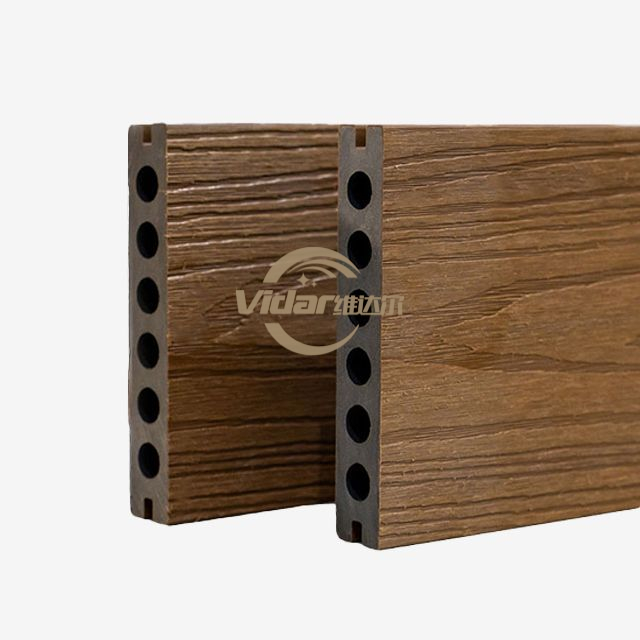
Modern engineering relies heavily on structural geometry. The physics of the arch play a crucial role in modern composite design. A circular void distributes downward force evenly across the surrounding material. Square-hollow boards typically fracture at their 90-degree internal corners. These sharp corners act as stress concentrators. When heavy pressure applies from above, the corners snap. Round hole co-extruded WPC decking eliminates these weak internal angles. The curved internal walls transfer pedestrian loads smoothly through the board's core into the substructure below.
The co-extruded shield provides the next layer of commercial viability. Traditional uncapped composites absorb moisture easily. A co-extruded board features a 360-degree polymer cap wrapped around the inner core. This shield prevents internal wood fibers from absorbing commercial-grade spills. Think about spilled wine at a restaurant, industrial cleaning chemicals, or grill oils. The non-porous cap blocks these liquids completely. It also provides a robust wear layer to resist high-traffic abrasion from constant footfall.
This specific profile optimizes the weight-to-strength ratio brilliantly. It successfully bridges the gap between competing commercial needs. You secure the budget-friendly and weight-reducing benefits of a hollow board. Simultaneously, you achieve the durable impact resistance required for busy environments. Installers handle lighter boards, reducing labor fatigue. Substructures require less reinforcement. Yet, the final floor withstands the daily rigors of public use confidently.
Before specifying hollow profiles for a commercial bid, architects and project managers must evaluate site-specific variables. Ignoring these criteria often voids warranties and causes early floor failures.
You must differentiate between stationary heavy objects and general foot traffic. Uniform loads spread weight across a wide area. Imagine fifty people mingling evenly across a hotel terrace. Hollow boards handle high uniform loads exceptionally well. Point loads, however, concentrate massive weight into a tiny footprint. Commercial pizza ovens, heavy bronze planters, and heavy-duty patio heaters create severe point loads. While round-hole profiles are strong, placing a 1,000-pound planter directly on them risks localized crushing. Installers must place solid timber blocking directly beneath these specific heavy items to transfer weight to the joists.
Substructure framing dictates the lifespan of any composite deck. Hollow composites demand stricter joist spacing than solid alternatives. Residential solid decks often utilize 16 inches on center (O.C.) spacing. Commercial hollow installations strictly require 12 inches O.C. spacing. Bringing the joists closer together prevents the boards from deflecting or sagging under heavy crowds. Stretching the span beyond manufacturer guidelines introduces severe bouncing. Over time, excessive deflection causes micro-fractures in the polymer shield. Always follow the strict 12-inch rule for public spaces.
Outdoor floors battle extreme climate shifts continuously. Freeze-thaw cycles represent the greatest threat to hollow chambers. If water enters a hollow core and freezes, it expands by roughly nine percent. This expansion exerts massive outward pressure, easily cracking the composite matrix. To prevent this, commercial installations require proper drainage slopes. Installers must pitch the deck structure slightly—typically a minimum of 1 to 2 percent grade (about 1/8 inch per foot). This subtle tilt ensures gravity pulls water completely out of the internal channels before freezing temperatures arrive.
Selecting the right board represents only half the battle. Poor installation practices ruin premium materials quickly. Commercial teams must adhere strictly to specialized installation protocols.
Exposed hollow ends trap moisture, dirt, and organic debris. Leaving board ends open creates an inviting environment for mold and insect nesting. Installation teams must follow mandatory rules for sealing every exposed cut. When finishing the perimeter of Hollow WPC decking, installers must use specialized matching caps. Alternatively, they can frame the deck perimeter using solid fascia boards. "Picture-framing" the deck layout effectively conceals all hollow ends while providing a clean, professional aesthetic.
Thermal expansion spacing demands precise attention. Composites expand and contract differently than traditional timber. When hollow boards heat up in direct sunlight, they grow longitudinally. If installers push boards tightly end-to-end, the heat expansion has nowhere to go. The floor will inevitably buckle upward, creating severe trip hazards. Teams must leave specific expansion gaps (usually 3 to 5 millimeters) between butt joints. These gaps allow the material to breathe naturally as daily temperatures fluctuate.
Fastening systems dictate structural integrity. You cannot treat hollow composites like solid wood. Hollow boards strictly require hidden fastener clip systems. These clips slide into the grooved side channels of the board. They secure the floor to the joist while still allowing slight longitudinal movement for thermal expansion. Face-screwing represents a critical mistake. Driving a screw straight down through a hollow board crushes the internal chambers. It voids warranties instantly. Furthermore, face-screwing creates permanent entry points for rainwater, accelerating internal degradation.
Hollow composite profiles are not universally appropriate for every commercial floor. However, round-hole co-extruded variants provide a highly capable, cost-effective solution for moderate-to-heavy pedestrian zones. They excel particularly on restaurant patios, hotel pool decks, and elevated rooftops.
When selecting materials, let logic guide your shortlist. Opt for round-hole profiles when weight reduction and upfront budget control act as your primary drivers. Reserve solid composite profiles specifically for ultra-high-impact zones or industrial areas enduring heavy wheeled traffic.
As your next step, avoid relying solely on marketing claims. Request technical data sheets (TDS) directly from the manufacturer. Scrutinize the stated crush strength (PSI) and the strictly recommended joist spans. Verifying these engineering metrics ensures your commercial outdoor floor delivers lasting safety and exceptional return on investment.
A: Yes, early or thin-walled hollow boards can produce a hollow, "drum-like" acoustic echo. High-density round-hole variants paired with hidden fasteners mitigate this resonance significantly. Securing the boards tightly at 12-inch joist intervals prevents the vibrations that typically cause excessive noise.
A: If installed perfectly level, yes. Proper installation requires a slight pitch (approx. 1/8 inch per foot) to allow gravity drainage. Alongside this pitch, you must ensure all board ends are properly sealed or covered with fascia to block water entry entirely.
A: Generally, yes. Because there is less overall mass to absorb and retain heat, they hold less thermal energy. The internal air channels also provide minor thermal breaks. As a result, hollow boards tend to cool down faster than solid boards in direct sunlight.
A: No. Face-screwing can crush the hollow chambers and create entry points for moisture. This practice compromises structural strength and voids warranties. Always use the manufacturer-approved hidden clip systems to secure grooved hollow boards safely.