Views: 0 Author: Site Editor Publish Time: 2026-06-30 Origin: Site


High-moisture environments like poolsides expose the severe limitations of traditional wood. High-exposure areas like sunny gardens also destroy unprotected natural timber. Splashing water, direct UV rays, and shifting weather patterns quickly degrade these surfaces. We often see wooden boards rot, splinter, and fade under these harsh conditions.
Many builders consider synthetic materials the industry standard upgrade. However, you cannot treat all composite boards equally. Not all synthetic lumber handles extreme micro-climates well. Some materials fail under constant chlorine exposure. Others warp when subjected to standing water or intense direct sunlight. Outdoor composite decking requires careful selection based on specific environmental stressors.
This guide provides a detailed technical framework for your next project. You will learn how to evaluate and select the correct synthetic boards. We explore structural profiles, extrusion technologies, and verifiable quality metrics. By understanding these structural differences, you ensure a safe and resilient outdoor living space.
Capped (co-extruded) WPC is strictly recommended for poolside use due to zero-permeability moisture shields.
Solid vs. Hollow profiles dictate load-bearing capacity and thermal retention; solid boards offer superior durability for heavy-traffic garden patios.
Reliable poolside WPC decking must carry verified slip-resistance ratings and demonstrated resistance to salt/chlorine degradation.
Long-term ROI depends not just on board quality, but on strict adherence to thermal expansion gaps and subframe ventilation during installation.
Every outdoor space presents unique environmental stressors. You must define these specific challenges to establish baseline performance requirements. A material that thrives under a shaded pergola might fail completely near a swimming pool. We must separate these zones to understand their distinct demands.
Poolside areas act as extreme micro-climates. These zones face constant moisture cycles from splashing water and wet bathers. The boards endure daily exposure to chlorine, saltwater, and harsh pool chemicals. Slip-and-fall incidents present a high safety risk here. Because people walk barefoot, the surface demands absolutely splinter-free textures. Sunscreen oils and lotions also drop onto the boards, creating stubborn chemical stains if the material remains porous.
Garden environments introduce a completely different set of stressors. Boards placed in open gardens face prolonged direct UV exposure. This intense sunlight acts as a bleaching agent, causing inferior materials to fade rapidly. Gardens also accumulate organic debris like fallen leaves, dirt, and branches. This debris traps moisture against the surface, elevating the risk of mold and mildew. Furthermore, ground-level moisture evaporates upward from the soil, hitting the underside of the boards and encouraging warping.
These challenges establish a strict baseline rule. Any material you consider must possess documented dimensional stability. It must resist warping under severe temperature fluctuations. It also requires high moisture-resistance credentials to survive both ground evaporation and surface puddles.
Manufacturing techniques define how well a board survives outdoors. We generally categorize these solutions by their production generation. Comparing these extrusion technologies helps you match the board to your specific environment.
Manufacturers create traditional uncapped boards by mixing wood fibers and plastics into a uniform core. The material remains consistent throughout the entire profile. Because the core lacks a protective outer shell, exposed wood fibers sit directly on the surface.
This first-generation technology works best for covered garden structures. You can confidently use it in low-moisture zones like enclosed patios or screened porches. It provides a highly authentic wood texture due to the exposed fibers.
However, this structure carries notable limitations. Uncapped boards remain susceptible to localized staining. When organic matter like wet leaves sits on the surface, the exposed fibers absorb the tannins. Over time, these boards show higher moisture absorption rates compared to newer generations.
Co-extruded technology revolutionized the synthetic lumber industry. Manufacturers take the standard composite core and wrap it in an impermeable polymer shield. High-quality variants feature a 360-degree wrap, protecting even the grooves and underside of the board.
This second-generation material is the premier choice for fully exposed garden layouts. More importantly, it is the only acceptable standard for Poolside WPC decking. The protective shield blocks out invasive elements entirely.
The primary advantage lies in its non-porous barrier. This shield repels pool chemicals, saltwater, and greasy sunscreen oils. It prevents moisture from reaching the wood fibers inside. As a result, mildew cannot root into the surface, making cleaning incredibly simple.
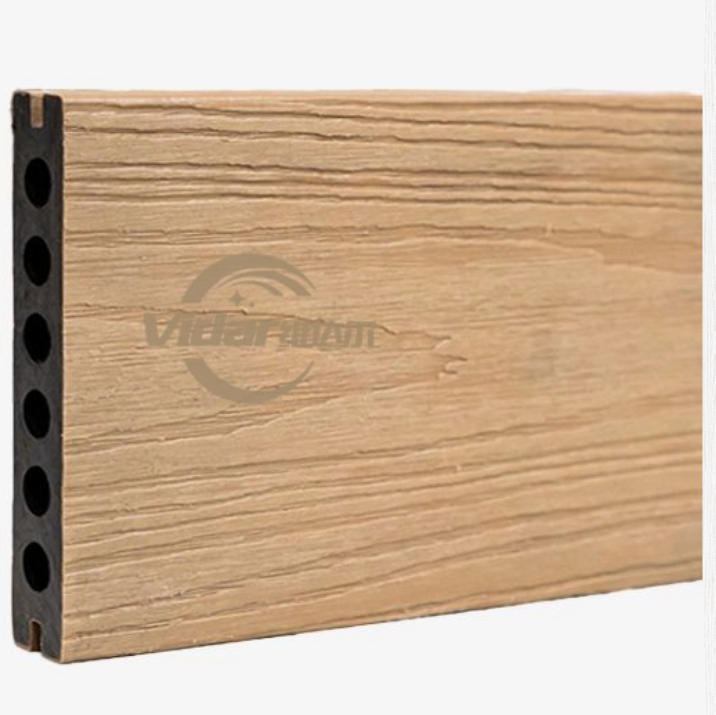
Your project’s scalability and structural demands dictate the board architecture you choose. You must align the physical profile of the material with your specific application. Solid and hollow profiles perform very differently under stress.
Solid boards consist of dense, unbroken material from top to bottom. They closely resemble traditional timber in weight and density.
These profiles offer maximum structural integrity. They handle heavy loads effortlessly, making them ideal for bulky garden furniture or massive concrete planters. Walking on solid boards mimics the dense, acoustic feel of real wood. They do not produce the hollow echoing sound often associated with synthetic materials. They also boast incredibly high impact resistance.
However, solid boards carry some practical drawbacks. They are significantly heavier to transport and maneuver on-site. Because they contain more dense material, they retain more thermal heat when exposed to direct, prolonged sunlight.
Hollow boards feature engineered channels running through the center of the profile. These voids reduce the overall mass of the product.
This design provides excellent material utilization, making them more lightweight. Builders find them easier to lift, cut, and position during installation. The internal channels also allow for faster heat dissipation. Air moves through the voids, helping the surface cool down quicker after sun exposure.
The main disadvantages stem from their open ends. They require precise end-capping to prevent water from pooling inside the channels. They also offer lower impact resistance; dropping a heavy, sharp object might puncture the top layer.
You must watch out for specific implementation risks. In wet environments, unsealed hollow ends become breeding grounds for mold. In colder climates, trapped water can freeze and expand, leading to freeze-thaw cracking.
Feature | Solid Profile | Hollow Profile |
|---|---|---|
Load Capacity | Excellent (Supports heavy items) | Moderate (Standard foot traffic) |
Weight | Heavy (Requires more labor) | Lightweight (Easier handling) |
Impact Resistance | High (Resists sharp impacts) | Lower (Prone to surface puncture) |
Thermal Retention | Retains heat longer | Dissipates heat faster |
Moisture Risk | Low (No internal cavities) | High if ends remain unsealed |
Moving beyond basic aesthetics, you must evaluate quantifiable safety and durability metrics. Visual appeal means very little if the surface becomes dangerously slick or structurally compromised.
Wet surfaces pose the greatest risk around swimming areas. You must actively look for manufacturer data regarding friction coefficients. Reputable brands provide specific R-ratings (Ramp tests) or P-ratings (Pendulum tests). Deeply embossed wood grain textures offer excellent grip. Brushed finishes also provide superior barefoot traction when wet. Avoid completely smooth profiles in any splash zone.
All composite materials retain heat under direct sunlight. Darker colors absorb solar radiation rapidly. You must evaluate thermal management strategies to prevent barefoot discomfort. Select lighter color palettes for direct-sun areas. Light grays, soft oaks, and pale ashes reflect sunlight efficiently. Some advanced manufacturers incorporate heat-reflective pigments into the polymer shield to mitigate high surface temperatures.
Never rely solely on marketing claims. Shortlist suppliers that provide independent testing data. Look for SGS, CE, or ISO certifications. These documents verify the material's load capacity and UV stability. They also guarantee toxic-free compositions. You want assurance that no harmful chemicals will leach into your pool water or surrounding soil.
Before ordering bulk materials, you need actionable steps to vet physical samples. Examining small offcuts reveals the true manufacturing standards of the product. Use these practical tests to ensure you select high-quality WPC decking.
The Cross-Section Test: Inspect the directly cut end of the sample. High-quality materials display a dense, highly uniform core. You should not see any visible air pockets, bubbles, or clumped wood fibers. Inconsistencies indicate poor extrusion processes and future weak points.
The Scratch Test: Take a standard house key or a coin. Apply moderate pressure and drag it across the surface shield. Premium capped boards will resist deep gouging. While minor scuffing happens, the polymer shell should never peel or tear away from the core.
The Density Check: Hold two different samples of the same size. The heavier sample typically indicates a higher ratio of High-Density Polyethylene (HDPE) compared to wood fiber. A higher plastic-to-wood ratio generally results in superior moisture resistance and longevity.
Even the most premium materials fail catastrophically if installed incorrectly. Experience dictates that poor workmanship ruins high-grade boards. You must strictly follow engineering guidelines to protect your outdoor space.
Thermal Expansion Gaps: Synthetic materials expand and contract longitudinally with temperature shifts. Boards grow in the heat and shrink in the cold. Failing to leave manufacturer-specified gapping at the butt joints leads directly to severe buckling. Always calculate expansion gaps based on the ambient temperature during installation.
Subframe Ventilation: Both garden and wet-zone layouts require massive airflow beneath the surface. You must maintain minimum ground clearances. Proper ventilation prevents moisture trapping. Without moving air, ground moisture rots the wooden subframe joists from the bottom up.
Joist Spacing: Never stretch the subframe joints too far apart. You must adhere strictly to maximum span requirements. For most standard residential profiles, this means keeping joists spaced between 300mm and 400mm. Exceeding this distance causes the boards to sag permanently under continuous foot traffic.
Selecting the correct materials requires matching specific extrusion types and structural profiles to your distinct environmental hazards. You must respect the damaging power of standing water, pool chemicals, and harsh sunlight. Relying on verifiable data, rather than aesthetics alone, guarantees a successful build.
For high-stakes areas like pool surrounds, you should strictly prioritize 360-degree capped solid boards. Ensure they carry verified slip-resistance ratings and chemical protection shields. For expansive garden walkways, highly dense hollow boards can provide excellent utility, provided you engineer proper drainage and ventilation into the subframe. By following these technical guidelines, you will create a safe, resilient, and beautiful outdoor living space that withstands the toughest micro-climates.
A: Yes, in direct midday sun, composites can become hot. Darker boards absorb significantly more solar radiation. Opting for lighter colors, utilizing shade structures, or selecting advanced boards with heat-reflective technology mitigates this barefoot discomfort effectively.
A: Uncapped traditional composite materials may degrade or discolor over time when exposed to harsh chemicals. Capped (co-extruded) boards feature a protective polymer shield. This advanced shell is highly resistant to pool chemicals, sunscreen oils, and salt accumulation.
A: With proper subframe ventilation and drainage, high-quality capped boards typically last 20 to 25 years. They experience minimal structural degradation or color fading. This lifespan far exceeds traditional timber, provided you maintain correct thermal expansion gaps during the initial installation.