Views: 0 Author: Site Editor Publish Time: 2026-08-31 Origin: Site


Failing to account for thermal expansion remains the leading cause of composite decking failure worldwide. This single oversight routinely results in severe structural buckling, permanent board warping, and instantly voided manufacturer warranties. The root of the problem lies in misunderstanding the material itself. Traditional timber expands primarily because it absorbs moisture from the surrounding environment. Conversely, WPC Decking expands and contracts strictly due to ambient temperature changes. If you ignore this physical reality during installation, your beautiful new outdoor space will literally tear itself apart over time.
Precise gap calculations rely on three crucial factors. Installers must evaluate the board length, the ambient temperature on the installation day, and the specific composite material grade. In this guide, we will explore exactly how to calculate these vital expansion gaps. You will discover the distinct measurements needed for width and length spacing. Finally, we will reveal how seasonal temperature swings should dictate your entire installation strategy.
Wood plastic composites contain a blend of natural wood fibers and synthetic plastic polymers. These plastic elements inherently undergo thermal expansion and contraction. It is a fundamental law of physics. When polymers get hot, they stretch outward. When they cool down, they shrink back. You cannot stop this movement. Instead, you must engineer your deck to accommodate it.
Many builders treat composite materials just like traditional lumber. This approach guarantees failure. Natural wood handles temperature changes fairly well. However, plastic polymers react aggressively to solar heat gain. Direct sunlight heats composite boards far beyond the ambient air temperature. As the boards absorb this thermal energy, they expand along their length and width. Without adequate space to move, these expanding boards will forcefully collide.
You must separate moisture concerns from heat concerns. Unlike natural wood, composite boards do not significantly swell from high humidity or rain. The plastic encapsulation protects the wood fibers from water ingress. Instead, composite materials stretch and shrink laterally due to UV exposure and ambient heat. A rainy day will not change the dimensions of your decking. A scorching summer afternoon absolutely will. Understanding this distinction helps you focus on temperature as your primary installation metric.
Implementing the correct expansion gap achieves several critical goals simultaneously. Proper spacing ensures sufficient structural tolerance for thermal movement. It prevents boards from buckling under pressure. Furthermore, accurate gapping guarantees adequate subframe ventilation. Heat must escape from beneath the deck to prevent the boards from cooking from the bottom up. Finally, appropriate spacing provides necessary debris clearance. Leaves and dirt can easily wash through the gaps, preventing mold growth and extending the deck's usable lifespan.
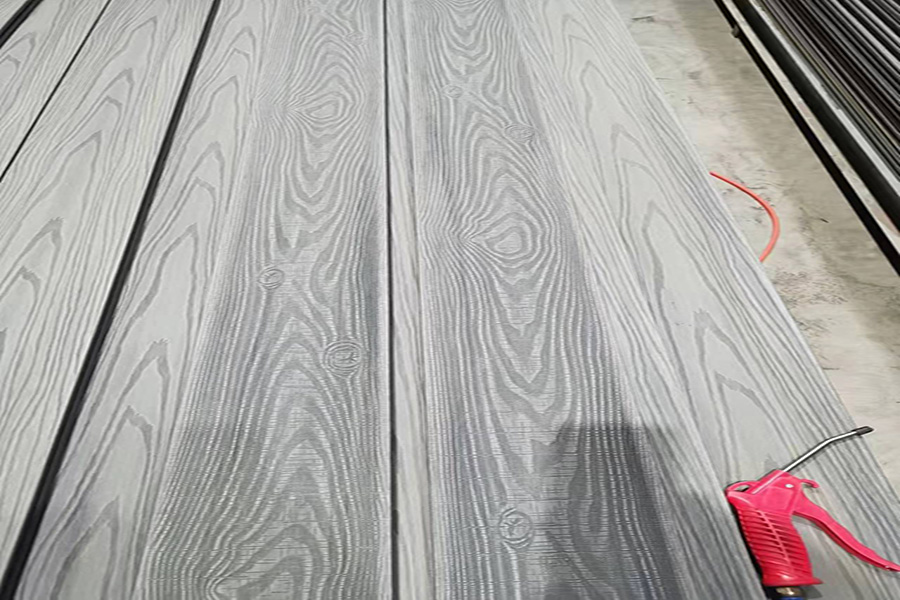
Every successful installation begins with standard baseline measurements. You must account for movement in two different directions. Boards expand across their width (side-to-side) and along their length (end-to-end). Each direction requires a distinct calculation.
The standard requirement for side-to-side spacing ranges between 4mm and 6mm. This equals approximately 3/16 of an inch. Boards expand less across their width than their length. However, this gap remains critical for water drainage and air circulation.
In implementation reality, installers rarely measure this gap manually. Modern decking systems utilize hidden T-clips or proprietary fastener systems. These fasteners automatically govern the side-to-side spacing. When you insert a standard T-clip between two boards, it dictates a perfect 5mm gap. You simply push the boards tightly against the clips. The hardware does the math for you. This ensures a uniform, aesthetically pleasing surface while guaranteeing adequate water runoff.
Lengthwise spacing presents a much greater challenge. Boards expand significantly more along their length. The standard baseline for end-to-end gaps typically ranges from 2mm to 8mm. This massive variance depends entirely on the board length. A standard 2.2-meter board requires much less gap space than a 5.4-meter board. The longer the continuous piece of plastic polymer, the more total expansion it will experience.
Wall and abutment spacing require even larger tolerances. You must require a minimum of 10mm to 15mm clearance where boards meet fixed structures. Fixed structures include house walls, concrete pillars, and structural posts. Houses do not move. Concrete does not yield. If your expanding board hits a brick wall, the board will lose. It will warp upward instantly. Always leave a generous perimeter gap to protect your investment.
WPC Decking Standard Spacing Reference
| Gap Type | Standard Requirement | Primary Purpose |
|---|---|---|
| Side-to-Side (Width) | 4mm to 6mm | Drainage, ventilation, and hidden clip placement. |
| End-to-End (Length) | 2mm to 8mm | Accommodating primary thermal expansion and contraction. |
| Fixed Structures (Walls/Posts) | 10mm to 15mm | Preventing structural collisions and massive buckling. |
You cannot blindly follow a generic gap measurement. The ambient temperature on the exact day you install the deck changes everything. Professional installers use a concept called "Delta-T" to calculate necessary tolerances.
The "Delta-T" represents the critical temperature difference. The required gap is dictated by the difference between the temperature on the day of installation and the maximum expected regional temperature. If you live in an area where summer temperatures reach 40°C, you must plan for that extreme. You measure the board's current state against its future maximum expansion state.
If you build a deck in July during a heatwave, your boards are already fully expanded. They hold maximum thermal energy. Therefore, end-to-end gaps should be minimal. You often only leave 1mm to 2mm of space between butt joints. Why? Because the boards cannot physically expand much further. When the weather cools in autumn, the boards will shrink. If you leave a massive 8mm gap during summer, winter contraction will stretch that gap to an ugly 15mm chasm.
Winter installations require the exact opposite approach. If you install on a freezing January morning, the boards are fully contracted. They sit at their smallest possible physical dimension. In this scenario, end-to-end gaps must be maximized. You will often leave 5mm to 8mm of space. You must leave room for the boards to expand when summer eventually arrives. If you install them tight in the winter, they will violently buckle during the first summer heatwave.
Boards stored in a shaded warehouse possess a different temperature than your sunny backyard. You must acclimatize the materials before cutting them. Best practice dictates leaving boards flat on site for a specific duration. This ensures they match ambient environmental conditions.
Material technology has advanced rapidly over the last decade. Early generation composites suffered heavily from thermal instability. Today, manufacturers offer sophisticated solutions designed to mitigate extreme movement. You must evaluate these material grades before calculating your final gaps.
Traditional uncapped composite boards utilize a simple, uniform mixture of wood dust and plastic. They perform well but react strongly to temperature swings. We now compare these to next-generation materials. Outdoor Co-Extrusion WPC Decking represents a massive leap forward in dimensional stability. Co-extrusion means the manufacturer creates the core and the protective outer shell simultaneously.
The secret lies in the 360-degree polymer shield. This capping surrounds a highly dense, engineered core. The premium polymer shell reflects more UV radiation. It prevents the core from absorbing maximum heat. Consequently, co-extruded boards provide a significantly lower coefficient of thermal expansion. They simply move less than their uncapped predecessors. The dense core resists bending, while the tough shell locks the internal fibers in place.
You must remember a critical fact. Co-extrusion boards still require expansion gaps. No plastic-based material is completely immune to thermal movement. However, their superior dimensional stability offers a much wider margin for error. If you miscalculate a gap by a millimeter, a co-extruded board is less likely to buckle aggressively. This technology reduces the risk of extreme structural failures. It provides superior long-term performance for climates with severe seasonal temperature swings.
Even with premium materials, poor installation practices will destroy a deck. Human error causes the vast majority of warranty claims. Let us examine the most frequent mistakes and how you can prevent them.
Standard butt joints represent the weakest link in any composite deck. When two boards meet end-to-end, they push against each other during expansion. You can eliminate this risk entirely. We strongly recommend using a picture-frame border or a central breaker board design. A breaker board runs perpendicular to the main decking field. Instead of joining two long boards end-to-end, you run them into the side of the breaker board. Since boards expand minimally across their width, this layout removes the most common point of expansion failure.
You must allow the boards to float slightly on the joists. Hidden clips secure the board while permitting microscopic lateral slides. Some installers mistakenly drive screws directly through the center of a board in multiple locations. Pinning a single board tightly in multiple spots restricts its natural movement. When the board tries to expand, the dual screws hold it hostage. The kinetic energy has nowhere to go. It forces the board to warp upwards, tearing the screws right out of the joists.
Many homeowners want to close off the bottom of their deck with solid fascia boards. This traps heat underneath. Insufficient joist clearance prevents natural heat escape. The trapped air essentially cooks the boards from underneath. This amplifies thermal expansion far beyond standard manufacturer calculations. You must maintain minimum ground clearances. You must provide cross-ventilation.
Mastering thermal expansion requires attention to detail, patience, and basic environmental awareness. Expansion gaps serve as a non-negotiable engineering requirement for composite installations. They are never a mere aesthetic choice. If you deny the material space to move, it will forcibly create its own space, destroying your deck in the process.
You must remember that exact gap measurements remain variable. Local temperature, regional climate, specific board length, and material quality all intersect. A premium co-extruded board will behave differently than a basic uncapped board. A summer installation demands a radically different approach than a winter build.
As an actionable next step, always consult the specific technical data sheet of your chosen decking line. Manufacturers test their specific chemical blends rigorously. Use their proprietary gap charts to finalize your layout plans. Select the approved fastener systems. By respecting the physics of thermal movement, you ensure your outdoor living space remains safe, flat, and beautiful for decades.
A: No. Even with minimal temperature shifts, side-to-side gaps are strictly required for water drainage. Without these gaps, water pools on the surface and seeps into the subframe. This trapped moisture eventually causes severe mold, mildew, and timber rot in your wooden joists.
A: No. Hidden fasteners primarily govern side-to-side spacing across the width of the boards. End-to-end butt joint gaps must always be manually measured. The installer must cut and space these joints based on the specific ambient temperature on the day of installation.
A: As temperatures rise, the expanding boards will collide. This immense physical force causes the decking to violently buckle or permanently warp upwards. It can easily snap hidden plastic clips or shear metal fixing screws in half. This immediately voids all manufacturer warranties.
A: Yes. Darker pigments absorb significantly more UV radiation and solar heat. This leads to much higher surface temperatures. Consequently, dark boards experience slightly more dramatic thermal expansion compared to lighter profiles. You must account for this extra movement during your gap calculations.