Views: 0 Author: Site Editor Publish Time: 2026-09-25 Origin: Site


Traditional timber and first-generation composites often fail under harsh environmental conditions. They inevitably succumb to moisture ingress, persistent fading, and progressive structural degradation. Builders and homeowners constantly face expensive upkeep and premature material replacement. To solve these recurring problems, the industry has shifted toward advanced co-extrusion technology. This manufacturing evolution serves as the current gold standard for mitigating environmental risks.
This article objectively evaluates the protective mechanics of modern capped boards. You will learn exactly how dual-layer engineering shields your outdoor spaces from decay. By understanding the science behind the surface, you can determine if the higher upfront investment aligns with your long-term performance requirements. High-quality WPC Decking represents a significant upgrade, and knowing how to evaluate it ensures a successful installation.
Modern composite outdoor flooring utilizes a highly specialized dual-layer anatomy. Manufacturers combine distinct materials to deliver both structural integrity and surface protection. We must look at how these distinct layers interact to understand why capped boards outlast their predecessors.
The inner core provides the essential foundation. It relies on a precise blend of recycled wood fibers and high-density polyethylene (HDPE). The wood fibers deliver excellent tensile strength and structural rigidity. The HDPE binds these fibers together, creating a stable composite matrix. This blend prevents the board from snapping under heavy loads. However, if you leave this core exposed to the elements, the wood fibers will eventually absorb water. This absorption leads to swelling, warping, and eventual decay. This vulnerability necessitates a protective barrier.
Manufacturers solve the core's vulnerability through co-extrusion. This sophisticated manufacturing process creates the protective shield. Extruders force a specialized polymer layer over the wood-plastic core at extreme temperatures. The core and the cap push through the shaping die simultaneously. They fuse together under immense heat and pressure. This process creates an inseparable physical bond. The cap completely seals the core away from external threats.
You must understand the difference between co-extrusion and basic post-manufacture coatings. Paint, topical sealants, and applied veneers sit superficially on the surface. When the board undergoes thermal expansion in the sun, these surface coatings fail. They peel, blister, or delaminate. The co-extruded cap behaves entirely differently. Because it fuses to the core at a molecular level, it expands and contracts alongside the board. It never flakes or separates.
Common Mistake: Avoid purchasing boards marketed as "coated" or "sealed" if they do not explicitly specify a co-extruded manufacturing process. Post-manufacture coatings provide only temporary protection.
You should evaluate outdoor building materials based on their ability to resist specific environmental threats. A co-extruded shield defends against three primary categories of degradation.
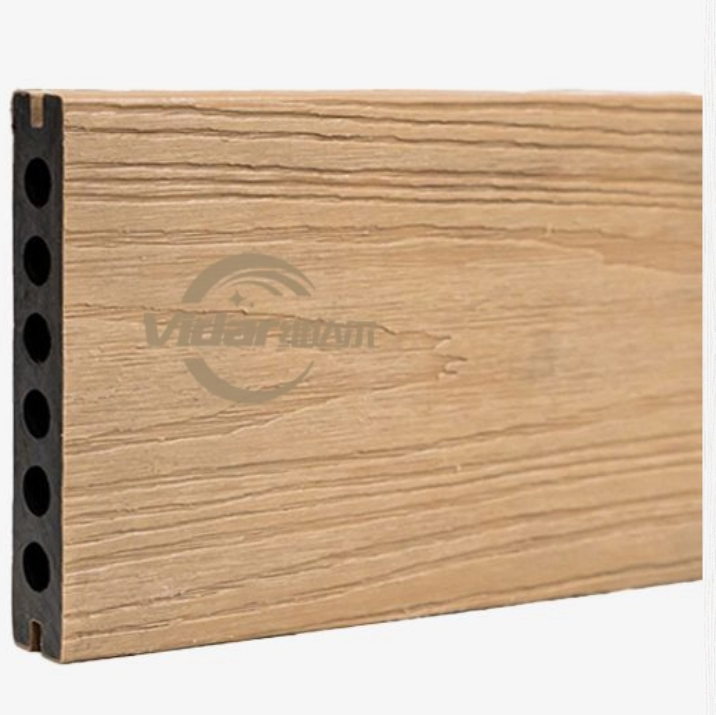
Manufacturers do not engineer all capped boards equally. Cap coverage dictates overall performance and suitable application areas. You must evaluate the extent of the polymer shield before purchasing.
Partial capping typically covers only the top surface and the visible side edges of the board. The underside remains completely exposed.
Full capping completely encapsulates the entire board. The polymer shield wraps around the top, the sides, the bottom, and inside the installation grooves.
| Feature | Partial (Half) Capping | 360-Degree (Full) Capping |
|---|---|---|
| Coverage Area | Top surface and side edges only | Top, sides, bottom, and inner grooves |
| Moisture Defense | Vulnerable to ground evaporation | Impervious to moisture from all angles |
| Dimensional Stability | Prone to cupping in humid environments | Remains flat and highly stable |
| Primary Application | Elevated decks in arid climates | Poolsides, ground-level, humid areas |
Co-extruded decking commands a noticeable price premium over first-generation composites and traditional pressure-treated wood. Buyers often hesitate at this initial expenditure. However, you must evaluate this investment through the lens of long-term value and eliminated labor.
Traditional wood requires relentless upkeep. You must purchase specialized cleaners, toxic sealants, and expensive stains every two to three years. You also expend countless hours sanding rough surfaces and replacing splintered boards. Capped composite materials eliminate these requirements entirely. You never need to sand, stain, or seal the surface. Your annual maintenance budget drops to near zero. You only need basic household soap and a hose to keep the surface pristine.
Uncapped alternatives degrade rapidly. Pressure-treated pine and first-generation composites typically follow a 10-15 year degradation cycle before requiring complete replacement. They succumb to rot, severe fading, and structural splintering. Conversely, a high-quality co-extruded board offers a realistic 25-30+ year functional lifespan. The polymer shield protects the core so effectively that the structural integrity remains uncompromised for decades.
When you map out the expenditures over a 10-year horizon, the math heavily favors co-extrusion. The cumulative cost of stains, sealants, replacement boards, and personal labor quickly surpasses the initial price premium of capped composites. By choosing fully encapsulated boards, you secure a significantly higher return on investment purely through avoided maintenance.
Manufacturers heavily market these products as "low maintenance." However, you must maintain transparent assumptions. Low maintenance does not mean indestructible. You must understand the material's limitations to ensure longevity.
Dense polymer caps retain heat differently than natural porous wood. In direct, intense sunlight, darker composite boards absorb significant thermal energy. They can become uncomfortably hot to the touch. If you are building a poolside area or a space where people frequently walk barefoot, you should prioritize lighter color selections. Light grays, tans, and pale browns reflect sunlight and remain much cooler underfoot.
Installation inevitably requires cutting boards to fit your specific layout. When you cut a fully capped board, you expose the raw, uncapped core at the ends. This exposed core acts as a sponge for moisture. You must address this vulnerability immediately. Installers must use matching end-caps, protective fascia boards, or approved edge sealants to cover the cut ends. Failing to seal these cuts compromises total moisture protection and voids many manufacturer warranties.
You cannot simply install the deck and forget about it entirely. You must perform baseline upkeep. Sweep organic debris like wet leaves and pine needles off the surface regularly. If wet leaves sit on the deck for months, they can eventually cause stubborn tannin stains. Perform a periodic soap-and-water cleaning to prevent general surface grime buildup. Ensure the gaps between the boards remain clear of dirt to allow proper water drainage.
Co-extruded caps provide unparalleled technical superiority in protecting the internal wood-plastic core. By fusing a high-density, zero-porosity polymer shield to the board, manufacturers have virtually eliminated the threats of moisture rot, UV fading, and deep staining. This dual-layer engineering ensures your outdoor space remains structurally sound and visually appealing for decades.
To achieve this promised lifespan, you must select the appropriate cap coverage. Always prioritize 360-degree full capping for high-humidity or ground-level environments. Furthermore, you must adhere strictly to correct installation practices, particularly regarding sealing exposed cut ends.
As a clear next step, contact suppliers to request physical samples. Test the scratch resistance yourself using a heavy object. Finally, evaluate the manufacturer's warranty carefully. Look for comprehensive coverage that explicitly guarantees against excessive fading, structural splintering, and moisture decay over a 25-year minimum period.
A: Yes, dense polymers absorb and retain more heat than natural wood under direct, intense sunlight. The material density slows heat dissipation. To mitigate this issue in barefoot zones like poolsides, we highly recommend selecting lighter-colored boards that naturally reflect solar radiation.
A: Deep gouges penetrating the cap are difficult to repair flawlessly. You cannot sand capped composites, as this destroys the protective layer. Minor surface scuffs may blend over time, but severe structural damage usually requires you to replace the affected board entirely.
A: UV inhibitors act as a chemical sunscreen dispersed throughout the polymer shield. They absorb or reflect harmful ultraviolet radiation before it can attack and break down the plastic's chemical bonds. This advanced technology prevents the color fading and surface chalking common in older composites.
A: Yes. Whenever you cut a board during installation, you expose the unprotected inner wood-plastic core to the elements. You must install manufacturer-approved end-caps, apply edge sealants, or use overlapping fascia boards to block moisture from entering these exposed ends.