Views: 0 Author: Site Editor Publish Time: 2026-09-05 Origin: Site


Investing in an outdoor space brings a common fear. Will your premium surface look washed out after a few harsh summers? You want an exterior living area retaining its rich appearance year after year. Relentless sun exposure constantly attacks surface pigments. Buyers often worry their beautiful dark boards will soon turn a chalky gray.
Wood-Plastic Composite offers remarkable resistance to rot and splintering. However, ultraviolet light represents the ultimate stress test for any exterior polymer-based material. Every exterior product eventually yields to the sun. Not all materials degrade at the same rate. Understanding how UV interacts with different composite generations remains crucial.
Acknowledging "zero-fade" as merely an industry myth helps you make sound procurement decisions. We will explore the photochemistry behind color shifts and evaluate modern protective caps. This knowledge ensures you specify the right material for unshaded environments without falling for unrealistic marketing claims.
Ultraviolet light carries high-energy photons. These photons strike the composite surface daily. They break chemical molecular bonds in both organic and synthetic materials. This process happens through a mechanism called photochemistry. Inside the exposed wood fibers, UV radiation breaks down a component called lignin. Lignin oxidation causes natural wood fibers to turn gray or bleach out completely. Meanwhile, UV light attacks the plastic polymers. This chemical breakdown causes polymer chain scission. The result leads to micro-cracking and chalking on the surface.
Early sun exposure triggers a distinct phase called extractive bleeding. Natural wood tannins wash out during early sun and rain exposure. You will notice this weathering happening rapidly in the first 12 to 16 weeks. The sun bakes the surface, drawing natural oils upward. Rain then washes away these loose tannins. This combination creates an initial color shift.
Once this initial shift occurs, the material reaches a stabilization point. Quality composite boards maintain this baseline color for years. Transparency matters greatly in building materials. No exterior material remains entirely immune to the sun. Success is measured by fade resistance, not fade prevention. Expecting zero color change sets an unrealistic baseline. Quality manufacturing focuses on slowing down degradation rather than promising impossible perfection.
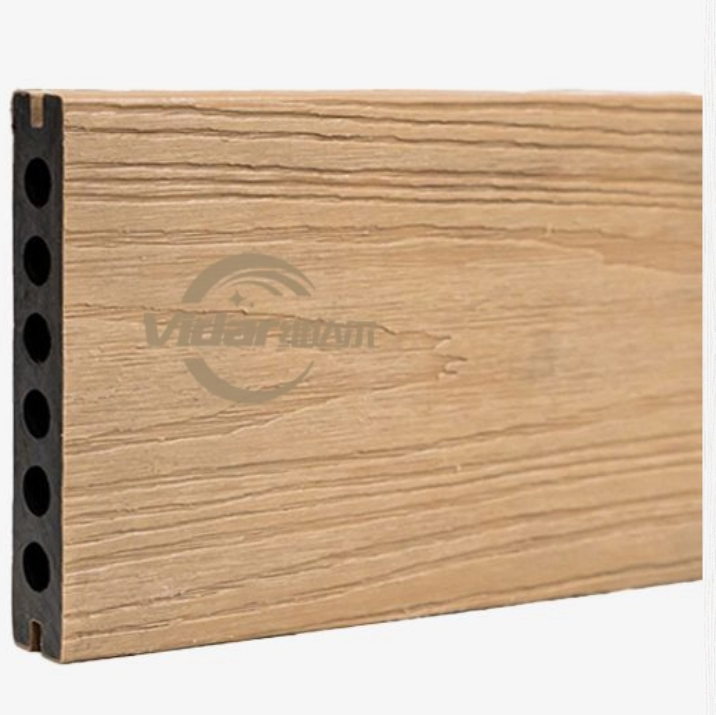
Comparing first-generation uncapped boards to modern WPC Decking,Anti-UV Capped WPC Decking reveals distinct differences in weathering behavior. We classify these options into two solution categories. First-generation represents standard uncapped composites. Second-generation features advanced co-extruded protective layers.
Uncapped boards remain highly accessible for entry-level applications. However, they expose raw wood fibers directly to UV rays. This exposure results in a more noticeable, uniform fade. The entire surface shifts to a lighter, weathered tone over the first few months. Some property owners actually prefer this rustic, muted appearance. The fading remains consistent across the entire deck space.
Conversely, capped boards feature a protective polymer shell. This outer shell acts as a powerful sunscreen for the inner core. Manufacturers extrude this shield simultaneously alongside the core. They integrate advanced UV inhibitors and colorfast pigments directly into this outer layer. These chemical stabilizers absorb and dissipate UV energy before it damages the polymer chains beneath.
Evaluating this through a decision lens highlights major aesthetic benefits. Choosing this upgraded material provides better aesthetic maintenance cycles. You avoid the heavy, uniform fading seen in early generation boards. The higher initial material commitment rewards you with decades of vibrant color. You spend significantly less effort worrying about sun damage and visual deterioration.
Structural design directly interacts with heat and light exposure. Direct sunlight drastically heats the composite material. Fluctuating temperatures cause physical expansion and contraction. You must evaluate implementation considerations carefully. Structural fatigue often begins under intense solar loads.
Hollow boards offer specific functional benefits. They feature a lighter weight and utilize less raw material. They possess lower thermal mass, meaning they cool down quickly after sunset. However, they carry notable risks. Thin walls face severe stress under direct sunlight. Excessive heat expansion from direct UV can easily cause warping. High-quality manufacturing becomes essential here. Inferior hollow boards will distort and bow under intense afternoon sun.
Solid boards provide superior dimensional stability. They handle fluctuating temperatures and intense sun exceptionally well. They represent the preferred choice for commercial spaces or unshaded residential patios. A solid core strongly resists the physical warping forces generated by severe surface heat. The dense structure minimizes thermal expansion rates across long spans.
Table: Structural Comparison in High-Sun Environments
| Structure Type | UV Heat Resistance | Dimensional Stability | Best Application |
|---|---|---|---|
| Hollow Profile | Moderate | Moderate | Partially shaded areas, mild climates |
| Solid Profile | Excellent | High | Commercial zones, direct sun exposure |
Standard capped boards handle typical sunlight remarkably well. However, extreme environments demand scalable premium solutions. Coastal areas, open deserts, and high-altitude locations expose materials to brutal UV indexes. Here, you should seriously evaluate ASA composite boards.
ASA stands for Acrylonitrile Styrene Acrylate. It boasts impressive origins in automotive and aerospace applications. Engineers developed it specifically for superior weatherability. Car manufacturers utilize ASA extensively for exterior trim pieces exposed to constant sun. It offers exceptional defense mechanisms against severe solar degradation.
Comparing performance metrics reveals clear advantages. We measure ASA capping directly against standard PE (Polyethylene) capping. ASA clearly wins in harsh, high-exposure climates. It demonstrates superior resistance to color fading, chalking, and gloss loss. Standard PE might gradually lose surface sheen under severe UV indexes. ASA retains its rich color depth and structural integrity much longer.
Shortlisting logic helps you finalize your material choice. Standard WPC Decking works perfectly for typical residential backyards. It offers excellent protection under normal environmental loads. However, upgrading to ASA makes sense in extreme environments. If you reside in a high-altitude mountain home, UV rays penetrate intensely. Choose ASA to protect your outdoor space effectively against rapid visual breakdown.
UV exposure goes beyond visual color fading. It dictates functional heat absorption. Solar radiation directly impacts the physical surface temperature of your outdoor space. We must shift our evaluation dimensions from aesthetics to physical comfort.
A strong color-temperature correlation exists across all composite materials. Dark colors absorb significantly more infrared radiation. Charcoals, deep grays, and dark browns trap solar energy rapidly. Light grays and tans reflect a large portion of this infrared energy. This phenomenon heavily impacts daily usability.
This creates genuine safety and comfort realities. Barefoot areas require careful planning and strategic material selection. Pool surrounds and unshaded residential patios become uncomfortably hot in mid-summer. We strongly advise selecting lighter colors for these specific zones. A light silver board feels drastically cooler underfoot compared to a dark mahogany board.
Chart: Estimated Surface Temperature by Color Shade
| Color Shade | Solar Absorption Level | Estimated Comfort Impact |
|---|---|---|
| Light Gray / Sand Tan | Low Absorption | Warm, usually barefoot friendly |
| Medium Cedar / Brown | Moderate Absorption | Hot, potentially uncomfortable midday |
| Dark Charcoal / Espresso | High Absorption | Very hot, strictly requires footwear |
What happens if your material eventually suffers severe sun damage over a decade? Many property owners wonder about risk mitigation and potential refinishing options. Understanding maintenance limits prevents costly, irreversible mistakes.
You face strict painting and staining limitations. You absolutely cannot and should not paint capped composite boards. Paint will simply not adhere to the slick, protective polymer shell. It will peel, bubble, and flake almost immediately. The protective layer repels moisture and traditional paints alike.
Uncapped boards present a slightly different scenario. Some severely weathered uncapped boards can technically accept stains. You must use specialized composite tints designed for synthetic fibers. However, staining introduces a permanent, recurring maintenance cycle. You must reapply the stain every few years. This completely defeats the original purpose of choosing a low-maintenance composite material.
Warranty awareness protects your expectations. Always read a manufacturer's "Fade and Stain Warranty" carefully. Manufacturers use Delta-E units to measure color shifts objectively. A small Delta-E number indicates minimal, almost imperceptible color change. Highlight standard industry exclusions inside these documents. Acceptable natural weathering differs greatly from defective manufacturing bleaching. Most warranties cover extreme, abnormal fading rather than gradual natural lightening.
Relentless UV exposure will continuously challenge any outdoor material. The sun acts as an unavoidable weathering force. Specifying the right generation of composite material effectively neutralizes the risk of severe fading. You can secure a beautiful outdoor space by aligning material technology with environmental demands.
Use this simple decision framework to guide your material selection process:
Take actionable next steps before finalizing your order. Request physical samples from your supplier. Leave them outdoors in direct sunlight for a full week. Test the heat retention levels barefoot during peak afternoon hours. Finally, review the specific fade warranty terms carefully to understand exact Delta-E weathering tolerances.
A: Standard uncapped composite boards experience an initial stabilization period lasting roughly 12 to 16 weeks. During this time, natural wood tannins wash out due to sun and rain exposure. The material shifts slightly lighter. After this initial weathering phase, the color stabilizes and holds steady for years.
A: Warranties differentiate between acceptable natural weathering and defective manufacturing bleaching. Gradual, slight lightening falls under natural weathering and is generally excluded. Severe, rapid color loss extending beyond acceptable Delta-E unit measurements indicates a defect. This abnormal bleaching typically qualifies for warranty replacement coverage.
A: No exterior material is completely UV-proof. Capped composite is highly resistant and guaranteed against significant visual shifts. The protective shell uses strong UV inhibitors. You can expect minor, gradual lightening over 10 to 20 years. This slow shift represents standard industry performance, not a product failure.
A: Structural UV degradation differs from visual color fading. While UV rays can weaken polymer chains, quality composite integrates advanced UV stabilizers directly into the plastic mix. These chemical additives prevent the plastic from becoming brittle. Without stabilizers, prolonged sun exposure could theoretically cause micro-cracking and chalking.